
Skip to content

Global Labour Institute

  • About Us
    • Our Team
    • Contact Us
    • The Global Labour Institute Network
    • Key Partners
  • Publications
  • Issues
    • Informal Work
    • Gender and Equalities
    • Climate Crisis
  • Trade Union Education
    • GLI International Summer School
      • International Summer School 2016
      • International Summer School 2015
      • International Summer School 2014
      • International Summer School 2013
      • International Summer School 2012
  • The GLI History Project
  • Latest
  • From guilds to gig work: the living history of trade unionism

    From guilds to gig work: the living history of trade unionism

    The trade union movement in Britain is at a critical juncture. While 2024-5 saw the country buck the OECD-wide density decline with a 0.4% rise, a long-term prognosis raises multiple causes for concern. Participation in Unite and Unison leadership elections has dropped to and below 10% respectively, while recent strike ballots across education, health, and the civil service have failed on low turnout. Even the TUC’s blog from this August celebrating the ‘record-breaking’ rise in membership acknowledged some of the foremost, palpable long-term threats: the proportion of members under 35 nationwide has sunk from a third to a quarter since 1995 in the same time that private-sector density has halved. 

    Considering new legislative overhauls, there is cause for the TUC’s optimism. Among other things, electronic balloting, lower thresholds for action in the public sector, and the protection of strikers could certainly even the odds for a trade union renaissance. Yet the impact of these measures will be restricted without the modernisation and opening-up of the unions themselves, particularly older, established unions with their foundations in the ancien régime of closed-shop heavy industry.

    The recent success of IWGB and other ‘indie unions’ is owed to their dynamism and initiative facing a neoliberal economy in constant revolution. This has allowed them not just to tiptoe into the fraught private sector but to galvanise some of its most disenfranchised workers, among them cleaners, couriers, and domestic workers. It is these constituencies of workers who will be most key to unions’ survival, but many have found established unions at best ‘slow to respond’ to their issues, and at worst exclusionary. As Daniele Palmer recently warned in Tribune, if unions fail to adapt to workers’ needs, ‘they will be pressed, reshaped, and, when necessary, taken over’. 

    Unions must adapt their approach as quickly and robustly as labour exploitation changes. To do so successfully, an appraisal of the history of the international movement throughout centuries of social and economic upheaval is vital. This year, GLI has published The Story of our International Labour Movement, a book by Dan Edmonds that seeks to use this history to encourage contemporary debate and discussion. 

    The book’s chronology begins in mediaeval Europe, but as Edmonds states, it could have begun in ancient times. Trade unionism grew alongside heavy industry, which allowed it the privileged position of its 20th-century heyday; this has provoked fears over the past decades that without industrial work, there can be no workers’ movement. Yet unionism predates the Industrial Revolution and has no reason to fade away in post-industrial society. Over centuries, a common thread of resistance has been shaped by constant upheaval within industry and labour, and it is this thread which must be tightly clutched as the movement faces new challenges.

    Under what Thompson termed the ‘equilibrium of paternalism and deference’ in pre-industrial Britain, different forms of union originated the social and economic roles that modern trade unions would later inherit. Guilds, organised by trade, sought to maintain their members’ monopoly of labour by representing masters and apprentices jointly. While successful in establishing protective statutes through direct petition to the government and local authorities, their internal contradictions exposed their insufficiency. 

    Even before industrialisation’s restructuring of labour, journeymen (skilled workers) organised into their own associations, stifled by the vertical, master-dominated guilds. Journeymen’s associations advocated for workers against their masters, using strikes, industrial sabotage, and blacklisting to force negotiations. Unleashing the worker as a political actor, independent of the oligarchy of their trade, set the stage for 19th-century labour relations. As enclosure and machination pushed forward capitalism’s development, the workers’ movement revolutionised itself to meet the needs of the workforce.

    Capitalism’s reorganisation of labour and the development of trade unions were duelling actors in a dialectical process. Supporting a cyclical view of labour history, the alienated, laissez-faire employment that capitalism requires was ‌in fact a regression for workers. The capitalists’ ‘conquest of social power’, as Marx wrote in Capital, required the removal of ‘the fetters they [guilds] laid on the free development of production and the free exploitation of man by man’. Following the days of artisanship, with its self-management and enshrined protections, waged employment more closely resembled the mediaeval relationship between lord and serf, or even the status of Rome’s plebeians. This analogy forged the language of the era that remains in use today: ‘proletariat’ (from the lowest class in Roman society), and of course, ‘wage slavery’.

    The working class in Britain and across Europe had been, Marx continues, ‘suddenly and forcibly torn from their means of subsistence, and hurled as free and “unattached” proletarians on the labour-market’. Without the protection of masters or guilds, workers therefore had to organise themselves in a new way, maximising their efficiency under boss- and state-led repression. Edmonds outlines succinctly how, at the dawn of the 19th century, the capitalists had laid the groundwork for their own enemies:

    More and more, the production of goods was being done by large numbers of people working together in a single site or place. Mass workers’ action was becoming a powerful reality.

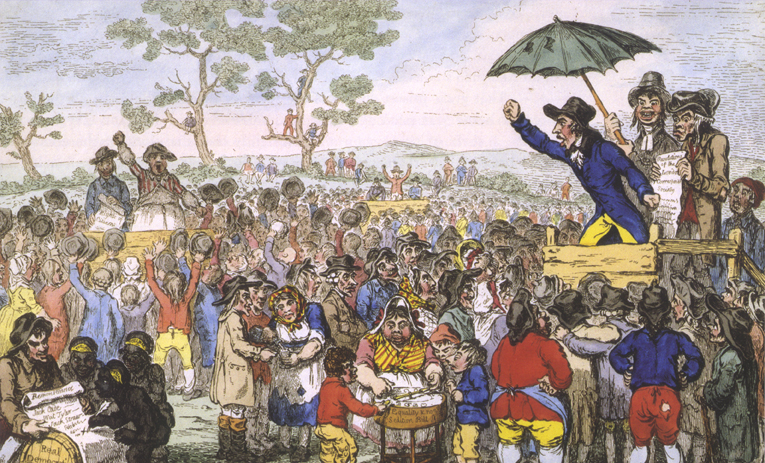
    The threat of spreading radicalism posed by the French Revolution, combined with organised pressure from powerful employers, led the British government to pass the Combination Acts of 1799 and 1800, universally outlawing trade unions, collective bargaining, and strike action. This repression unwittingly bolstered the movement. Unable to organise in the open, trade unionists went underground, and the threat of repression drove them to create more robust ‘societies’ that eventually grew to unite different industries. As history marched on, these structures would adapt and eventually formalise, shaping the organisations that compose the established union movement today.

    While many official trade union histories have neglected the prehistory of guilds, journeymen, and clandestine societies, the situation today demonstrates the lasting value of these lessons. The problems of post-industrial Britain mirror that of laissez-faire early capitalism: the gig economy’s denial of workers’ rights through subcontracting and self-employment has left four million workers ‘missing out on key statutory rights, including parental leave, redundancy pay and protection against unfair dismissal’. While the traditional unions have made efforts at the national level to bring change in employment law, some of which have been successful, their ‘rigid and hierarchical organisational structure[s] makes it difficult to reorient their strategies’.

    Just as the oligarchy of the guilds gave way to the independent networks of journeymen, the vigour and adaptability of new organisations will be key to cutting a new path for the movement. Trade unionism must move forward with a push from below, branching into and across a working class in constant revolution. 

    Building on its longstanding partnerships with national and international trade unions, the Global Labour Institute (GLI) is developing a political education programme around the publication of The Story of Our International Trade Union Movement. Through events, workshops, educational resources and digital content, the programme will help trade unionists and labour activists understand the history of the international labour movement and connect it to today’s organising challenges. It is aimed at both newer activists and experienced trade unionists interested in exploring the historical roots of current debates.

    Danny Tye

    September 23, 2026
    Latest, Uncategorized
    GLI, unions, workers
  • Ukraine: Support workers’ struggle for labour and union rights

    On 19 July 2022, in the middle of a war, the Ukrainian parliament adopted Draft Law 5371, which abolished labour rights for 94% of Ukrainian workers. This law introduced extreme liberalisation of labour relations, depriving workers of union protection. 

    The Ukrainian trade unions actively opposed this anti-labour draft law for two years. But despite many warnings from the International Trade Union Confederation, the European Trade Union Confederation, and the International Labour Organization, the Ukrainian parliament adopted it. 

    This new law will lead to a massive violation of workers’ rights — and Ukrainian unions are asking for our help and support in telling Ukrainian President Volodymyr Zelensky to veto the law.

    Please sign this petition to show support for the Ukrainian workers today.

    Georgia

    August 15, 2022
    Latest
    GLI, labour, ukraine, workers
  • #ISS14: Stay Together for the Kids or Divorce? Unions and Social Democratic Parties

    This article draws on the plenary Union-Party Relationships: Stay together for the sake of the children or get a divorce?

    There’s a few ways to think about unions and their relationship with parties. Warring lovers? Separated? Have parties already left their former union bedfellows? Here in the UK, the relationship is certainly on the rocks. It’s not the only country where that’s the case, though.

    India

    1974 saw one of the country’s biggest strikes, when 1.7m rail workers walked out. It was brutally crushed, with 1000s fired and jailed. ‘A reign of terror was unleashed’, says Sujata Gothoskar from the Forum Against Oppression of Women, India.

    Three years later, the union leader was Minister for Industries – forcing the still-fighting workers to go quit their struggle.

    It’s a telling example of the effects parliamentary activity under capitalism. And it’s not an isolated case – the large Communist Party of India (Marxist) has many such examples. Meanwhile, the Congress Party is now committed to neoliberal policies, while the recently elected BJP poses an even more frightening future for workers. Existing parties are a ‘no-no’, then.

    But the union movement in India is deeply divided, growing out of the national independence movement in a country with a definite lack of class politics – differences of caste, gender and a whole host of other divisions spring up.

    In the messy political situation post-independence, unions were firmly linked with ‘their’ party, while independent unions were often viewed with suspicion.

    It might partly explain why density is just 8% today. At the same time, unions’ political clout has been shrinking – in 1971, 21% of parliamentarians were linked with unions. By 2004 it was 4%. Now, it’s around 2%. So the chance of union-friendly policies is arguably remote; unions aren’t even consulted anymore by government.

    But in this midst of this political decline and division, independent organisations are forming, despite (or perhaps because of) the neoliberal onslaught India has been subjected to since the ‘90s. At the company level, unions are emerging free of partisan strangleholds. The Self-Employed Women’s Association has soared to over one million members in just a few years.  Cross-party platforms are developing within central trade unions, and there are attempts to form an independent federation of unions.

    Such initiatives complement the emergent broad fronts – including battles for the right to food or work, some of which have been successful. Alliances with women’s groups, human rights organisations and sexual minorities are forming, bringing the most disenfranchised into contact with the union movement.

    These movements lack a partisan voice however, one with the power to actually implement their desired policies. For Sujata Gothoskar, it’s time for a new workers’ party. The chances, in a country and a left-wing still deeply split, are admittedly remote.

    South Korea

    Options in South Korea look similarly problematic.

    The union movement there after World War Two was fiercely repressed. But, perhaps ironically, neoliberalism in recent years has coincided with democratisation – allowing, as in Brazil and South Africa, some institutionalised power. This ‘taste of political power’ only came when unions were legalised in 1998, says Lee Changgeun, Policy Director at the Korean Confederation of Trade Unions (KCTU)

    But are party links the way forward? There are several possible routes to political influence, including union-party links; collective action – such as general strikes in Italy, France and Spain; social pacts like in Sweden, Germany and others; lobbying in the US or electoralism in the UK, Brazil and South Africa.

    Yet Korea lacked a progressive party until 2001, following the failure of both a general strike and a social pact with government and employers. The Democratic Labour Party (KDLP) was formed, winning ten seats in 2004 and five in 2008. Yet it soon split over a corruption scandal, before reuniting…and then in 2012 splitting again.

    The path to power looks like one ridden with pot-holes. Such flaws provoked the KCTU to adapt a more pragmatic policy, dropping exclusive support for the KDLP in 2012.

    Within the KCTU, around half of union members blamed union members themselves for the partisan chaos. Most, however, primarily blamed the party.

    But for the KCTU, the problem was that it treated members as political subjects – merely mobilising votes and finance for party through ‘political substitutism’, leading the body to lose capacity and a leading role to deal with conflicts.

    Two years on, 62% of members feel strongly they need a progressive party – a class-based party, in fact. And 40% of members think the KCTU should be the one to found it. It’s a daunting prospect.

    For now, the union has set itself on a ‘workers political empowerment’ campaign, putting party issues within the context of that broader project. At some point however, the question of party politics may have to be revisited. As in India, it’s an unenviable prospect.

    Germany

    The decades following the Second World War in Germany was filled with student radicalism and a revival of discussion following democratisation. Many left wing groups emerged in student circles – but often ignoring workers themselves! In this context, Karin Pape (GLI Geneva) found unions a safe haven, becoming involved in a Luxembourgist organisation called Gruppe Arbeiterpolitik and reaching out.

    After university, such radical students entered the workplace – often as union staff – and often became key radicals – in spite of not being in the Social Democrats, which by 1959 had abandoned Marxism. Yet the paid staff of the unions were entirely Social Democratic. And if you weren’t, well, you weren’t hired. Within companies though, communists were often elected for being excellent activists – but in spite of not being SPD. But the relationship between the SPD and the unions was fairly fluid – there was no element of control. ‘Unions didn’t really tell members to vote SPD…they just expected it!’

    But perhaps at the heart of this relationship was a constant fear of the alternative, i.e. workers supporting the USSR. So concessions such as the welfare state were granted.

    The Fall

    This all changed after the fall of the Berlin Wall. Once the USSR was finished, such concessions weren’t necessary anymore. The Social Democrats, like many European parties, became neoliberal, even when the Christian Democrats would not dare.

    Since then, union/SPD links have been fraught. Many trade unionists are now Green or support the Left Party. And the food workers union recently elected a woman who was not a member – both being firsts!

    There are positives and negatives however. Now, there is no ideology or political direction within unions. Unions simply draw up demands, check them against party platforms and ask members who to vote for. The politics is lost.

    So, stay together or divorce? Unions and the SPD are an old couple – they’ve missed the divorce (and as Dave Spooner said, there’s definitely no ‘sex’ anymore). As for the children, they’ve forgotten about them. That, perhaps, is the most worrying thing.

    Maybe the same applies to the relationship between social democratic parties and unions across the world…

    Josiah Mortimer is a guest blogger for the Global Labour Institute’s third International Summer School for trade unionists at Northern College this week. The views expressed in this article are therefore solely those of the author in his personal capacity and do not necessarily represent the views of GLI.

    You can follow all of the conference online on the GLI site, through Union Solidarity International, and on Twitter: #ISS14.


    Josiah

    July 9, 2014
    ISS14
    Germany, India, ISS14, Korea, labour, neoliberalism, parties, party, social democratic, social democrats, unions, workers
  • #ISS14: Public services under attack – international austerity and the fight-back

    Speaking to the Global Labour Institute’s 2014 International Summer School, Rosa Pavanelli, General Secretary of Public Services International, gave an account of the struggles public service workers are facing. This article draws on her speech to delegates in Tuesday’s opening plenary.

    Public service jobs used to be considered the gold standard in much of the world. Well paid, good pension, decent holidays and solid trade union rights. In an era of neoliberalism however, these previously ‘most formal of formal workers’ are facing the kinds of attacks previously only associated with the most ruthless companies.

    International Struggles

    There’s an ideological background to this. Labour market and union ‘reform’ has been factor in almost all post-crash countries. In South Korea, the government has recently initiated the most violent attack on public services – derecognising unions in each sector. Privatisation of the rail industry and the mass firing of union activists have turned the country into what one delegate called ‘a war zone’ for workers.

    Public Services International, the Global Union Federation for public service workers, is used to privatisation battles – organising in industries which are often publicly funded and subsidised, but increasingly privately owned.

    In the US, the Supreme Court last week ruled that there’s no obligation for care workers to pay union dues to unions collectively bargaining for them. These workers often work alone. They are now even more isolated – especially if their unions become toothless in the face of the court decision.

    And internationally, at the last ILO conference, for first time delegates couldn’t reach a conclusion on the centrality of the right to strike – despite convention 87 of the ILO convention deeming it fundamental – because employers were so strongly against. It’s a frightening turn for workers of all sectors, as that is one of the only legal bases unions have on the global scale.

    But there is some good news. The UN Women’s organisation recently recognised the role of unions as key to addressing the problems of women.

    Moreover, until recently trade unions were previously not allowed to participate in UN discussions on migration. Now, after years of struggling from PSI and others, they can. With migration becoming a vehicle for new kinds of slavery, it’s an important milestone.

    For public service workers, the water campaigns in the UN are equally important. In 2010, water was deemed a human right, providing the legal background for the massive 2013 struggles in Europe for water to be publicly owned – many of which won, in Paris and elsewhere.

    And in the IMF, Christine Lagarde has recently said austerity is creating more injustice and poses a threat to democracy.

    A turning point?

    The ruling class, then, is getting scared. We are at critical point of class conflict. In response to a global ruling class, unions must likewise organise internationally, not just in one workplace. The welfare state wasn’t won in one shop floor but by the entire working class.

    Multinational capital has a strategy. Unions can’t afford to navel-gaze. Whether in care homes, railway stations or outsourced water plants, public service workers in today’s climate of privatisation, cuts and union-busting know this better than ever.

    Josiah Mortimer is a guest blogger for the Global Labour Institute’s third International Summer School for trade unionists at Northern College this week. The views expressed in this article are therefore solely those of the author in his personal capacity and do not necessarily represent the views of GLI.

    You can follow all of the conference online on the GLI site, through Union Solidarity International, and on Twitter: #ISS14.

    Josiah

    July 8, 2014
    ISS14
    austerity, cuts, GLI, GUF, neoliberal, neoliberalism, privatisation, PSI, public, public services, sector, UN, unions, water, workers
  • #ISS14: How workers can win

    There’s a question every trade unionist must stop and ask at some point: ‘what am I organising for?’

    Kirill Buketov (image from USi)
    Kirill Buketov (image from Union Solidarity International)

    For Kirill Buketov, international campaign officer of the International Union of Food and Allied Workers (IUF), the central driver behind is fundamentally that ‘we are dissatisfied with the way the world is run.’ Putting this into positive action means being political – and possessing a few vital qualities.

    Buketov raises some examples. In Moscow under the Soviet Union ‘what really shook the system is when workers went on strike.’ But to be successful, it took organisation and leadership. At first, workers struck without any idea what they wanted – state officials simply sent them back to work until they had some demands. It was only when they had a strategy that change began. In contrast, the Occupy movement was unsustainable and didn’t last because it lacked organisation.

    For Buketov, every conflict is at root the same – ‘you need organisation, strategy and commitment to win – to fight until the very end’. He points also to the Kazakhstani oil workers’ struggle in 2011 when 26,000 workers walked out for six months. It was brutally crushed and achieved nothing. Why? They decided not to have organisation, changing their negotiators every time. There was no strategy or organisation.

    But the most poingnant example is today in Ukraine. There, the Maidan movement was a genuinely popular democratic movement – and it achieved Yanukovich’ resignation. But right-wing forces abused the situation to lead the country after the left failed to create structures, organisation and strategy for when Yanukovich resigned. In sum, the right-wing were more prepared.

    In a global economy however, if we want to be organised, we must work cross-borders. That’s where social media steps in – rank and file cross-border movements can utilise Facebook and Twitter to help build international platforms for organising people to fight and win.

    The recent Thai shrimp industry slavery scandal, which the IUF is currently working on, shows that operating internationally for solidarity across borders is more vital than ever. To win, workers will need the ‘organisation, strategy and commitment’ that Buketov stresses is necessary. And with 250,000 slaves in the industry, they really do need to win.

    Josiah Mortimer is a guest blogger for the Global Labour Institute’s third International Summer School for trade unionists at Northern College this week. The views expressed in this article are therefore solely those of the author in his personal capacity and do not necessarily represent the views of GLI.

    You can follow all of the conference online on the GLI site, through Union Solidarity International, and on Twitter: #ISS14.

    Josiah

    July 8, 2014
    ISS14
    food, IUF, labor, labour, occupy, organisation, strategy, strike, unions, workers
  • #ISS14: The secret war on workers in Asia

    This article draws on the plenary ‘The Fall & Rise of Labour?’ at the GLI International Summer School.

    There’s a war going on in Asia – and it’s one that, unlike ISIS in Iraq or the chaos in Syria, is failing to make the headlines. It’s the war on workers that is taking place across much of the continent, according to the Executive Director of the Asia Monitor Resources Center in Hong Kong, Sanjiv Pandita.

    The geographer David Harvey has termed this process ‘accumulation by dispossession’. Across the continent, workers are being forced off their land to make way for plantations, mining, or even real estate. They’re resisting – but employers and police are using the age-old methods of repression.

    The recent surge in attacks on citizens has been propelled by the expansion of neoliberal policies in Asia, including controversial ‘export processing zones’ which lack any labour or environmental standards. In such areas, ‘everything is a commodity’ according to Pandita, particularly when inequality has soared in Asia, and particularly China, more than any other region of the world over the last 20 years.

    And the figures are astonishing. 300 million people – almost the US population – are currently on the move in Asia, forced from rural land into the cities. This scale is ‘unprecedented at any time in the history of the industrial world’.

    Of course, some end up in the factories that spring to mind in your head – the Yue Yuen factory in China where 80,000 shoe workers recently struck, or Foxconn where your iPhone was probably made. Most workers, however, don’t end up there.

    Most will find themselves in an even more unregulated informal economy – picking shells, working informally on construction sites, gathering rubbish, and sex work. Informal work like this ‘employs’ up a quarter of Asia’s total population – one billion people. That’s 70% of total vulnerable employment in the world. It’s dangerous work, too. Over one million people die every year from work-related deaths in the region, according to conservative estimates.

    These workers are not only dispossessed from their land and resources – forced out by multinationals with the help of the local state – but from their rights. And with very often no identifiable employer – whether because the supply chains are so long or because they are ‘self-employed’ – organising for better conditions is hard. But it can be done.

    Following the Rana Plaza garment factory collapse in Bangladesh, the last year has seen some of largest strikes in Asia’s history. Again, the numbers are eye-watering. 100m workers in India went on strike last year – in one day. Millions stopped work in Hong Kong, Indonesia, and Bangladesh, the latter of which won a 50% wage hike in the textiles sector. Cambodia similarly saw a major general strike last December, met with a violent crackdown. And in Korea – mostly informal workers took radical action, particularly bricklayers.

    Within these struggles, the question of unity between ‘formal’ and informal work has to be addressed. ‘We have to believe all working people are one – no matter what they are doing’, Pandita says. The question is how to bring all of them together. New ways of organising are occurring – the challenge, with no or secretive employers, is how and where to bargain. Instead, the bargaining must be political.

    Even where informal workers are organising however, it is often separately. Home-based workers, sex-workers and street vendors are getting organised – but not as one.

    In such situations, the question of leadership also emerges, somewhat problematically. Movements often draw external middle-class organisers who take over. Yet ‘the agents of change have to be workers themselves. We have to just be catalysts.’ Perhaps the current situation is just a temporary phase while grassroots leadership develops.

    From Western workers, solidarity has to be genuine – ‘it can’t be based on pity’. Movements against ‘accumulation by dispossession’ are rising up, and the challenge for those in the global North is to offer solidarity without co-opting them. One thing is certain however – with living standards in the West being crushed by austerity, ‘all of us are workers now’. It’s time to start organising like we believe it.

    Josiah Mortimer is a guest blogger for the Global Labour Institute’s third International Summer School for trade unionists at Northern College this week. The views expressed in this article are therefore solely those of the author in his personal capacity and do not necessarily represent the views of GLI.

    You can follow all of the conference online on the GLI site, through Union Solidarity International, and on Twitter: #ISS14.

    Josiah

    July 8, 2014
    ISS14
    asia, formal, informal, labour, precarious, Rana Plaza, strike, unions, war, workers
  • International Summer School 2014 Begins – Welcome!

    Today marks the start of the third Global Labour Institute International Summer School at Northern College in Barnsley.

    Over 80 labour movement delegates from 28 countries have descended on Barnsley for an inspiring week of debate, discussion and education on the situation of the international labour movement and its politics in the 21st century.

    Workers in 2014 face enormous challenges, from austerity to ecological destruction and political turmoil. #ISS14 hopes to provide a platform for debate as to how to deal with these global crises and to inspire a new generation of global union activists.

    The International Summer School this year comes at a time as Britain is preparing for potentially its largest day of strike action since the General Strike of 1926, which will be taking place this Thursday.

    Our team of conference rapporteurs and Union Solidary International (USi) will be live-blogging and reporting on the Summer School over the course of the week, both on the GLI and USi blogs. Feel free to get in touch if you have any questions – whether in person or on Twitter.

    Make sure to follow and contribute to the debate on Twitter using the hashtag #ISS14 and following @GLI_UK and @USILive.

    A huge welcome from the GLI team to those who have travelled far and wide for the Summer School!

    We hope you have an excellent week and come away feeling re-energised and ready to take on the threats to workers across the globe.

     Solidarity!

    Dave

    July 7, 2014
    ISS14
    GLI, global, Global Labour, international, labour, movement, Union, USi, workers

CONTACT

gli-uk@global-labour.net

Global Labour Institute
(GLI Network Ltd)
535 Royal Exchange
Manchester
M2 7EN
UK

OUR SITE

Home

About Us

Publications

Issues

Trade Union Education

GLI History Project

Latest

KEEP IN TOUCH

  • X
  • LinkedIn
  • Facebook

The GLI Network Limited is a limited company registered in England and Wales, company number 07378368

GLI Manchester is part of the GLI Network

Privacy Policy

Site created by greenh & hosted by Webarchitects Co-operative