Global Labour Institute

  • About Us
    • Our Team
    • Contact Us
    • The Global Labour Institute Network
    • Key Partners
  • Publications
  • Issues
    • Informal Work
    • Gender and Equalities
    • Climate Crisis
  • Trade Union Education
    • GLI International Summer School
      • International Summer School 2016
      • International Summer School 2015
      • International Summer School 2014
      • International Summer School 2013
      • International Summer School 2012
  • The GLI History Project
  • Latest
  • StreetNet International & GLI collaborate on Barometer Project

    StreetNet International & GLI collaborate on Barometer Project

    Informal street vendors and market traders make huge economic and social contributions, but many workers major challenges at work, including insecurity, long working hours, poor working environments, violence and harassment, lack of affordable finance and low levels of representation.

    In 2024, StreetNet International (SNI) – a global alliance of organisations of street vendors and informal economy workers – partnered with the Global Labour Institute (GLI) in Manchester to launch the ‘Barometer Project’ with the aim of understanding in greater detail the situation facing affiliated members and workers. Through the collection of data through surveys, focus groups and in-depth interviews, the project was launched with several objectives including:

    • Gaining a detailed understanding of the characteristics, livelihoods and key issues faced by street vendors and market traders.
    • Informing SNI on key thematic areas for exploration, particularly related to opportunities for the formalisation of informal employment (improved livelihoods & working conditions, protection from harassment & violence, freedom of association, the right to work without restrictions, access to social protection, a& recognition, engagement in collective bargaining & consultation with authorities).
    • Building the capacity of SNI affiliates to monitor workers’ conditions and collect evidence to support engagement with national and international authorities and policymakers. 

    The project was based on a participatory research methodology – through the active engagement of trade unions and membership-based associations organising and representing workers in the informal economy and built on vendors’ and traders’ own experiences and knowledge. SNI affiliates were actively involved in the research process – two cities were chosen for piloting the project – Harare, Zimbabwe, working with Zimbabwe Chamber of Informal Economy Associations (ZCIEA) and Buenos Aires, Argentina, working with the Union de Trabajadores de la Economia Popular (UTEP). 

    The project findings were also used to support SNI’s participation in the 2025 International Labour Conference (ILC) general discussion on promoting transitions towards formality, during which SNI advocated for an inclusive and rights-based formalization.

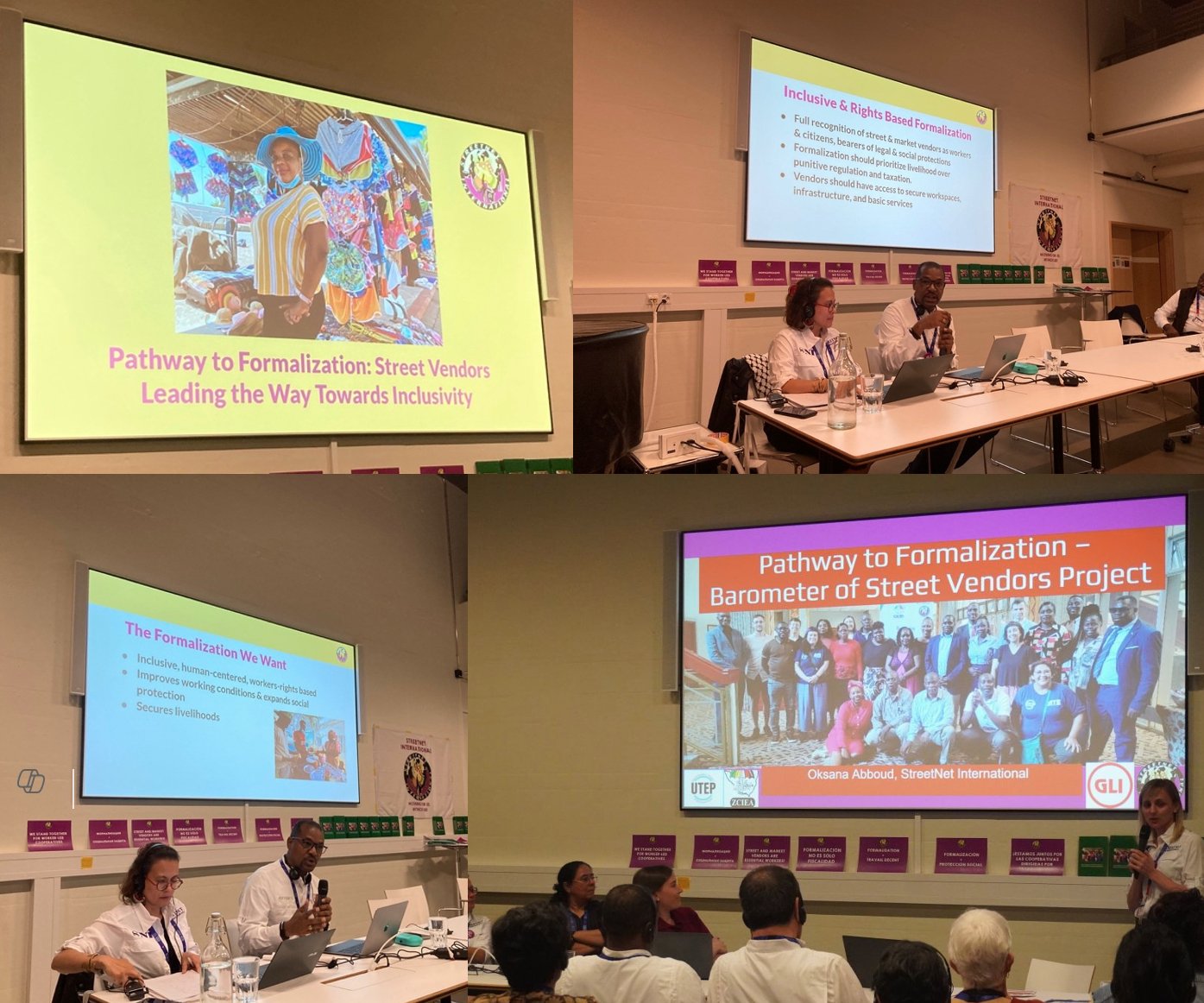
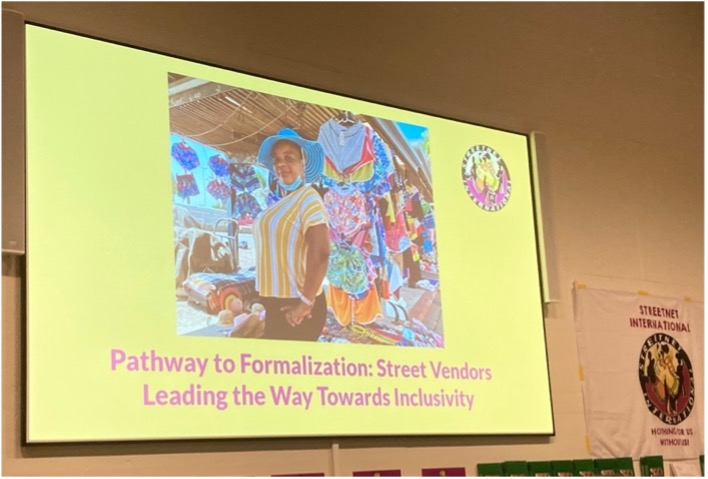
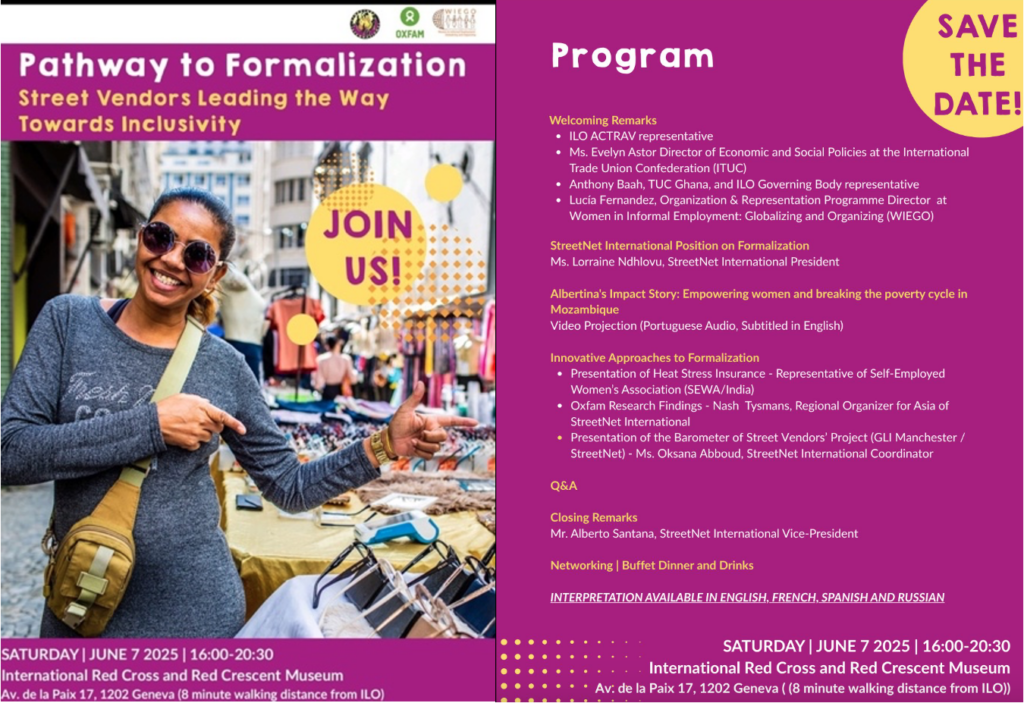
    On 7 June, SNI also hosted a side event to the ILC: ‘Pathway to Formalization: Street Vendors Leading the Way Towards Inclusivity’ 

    During the event, SNI laid out its vision for formalization – rooted in workers’ rights, dignity and the principles of the social and solidarity economy. It also provided the opportunity to share best practice and innovative research, including the key findings from the Barometer project.

    [Image: SNI Formalisation Presentation Slide]

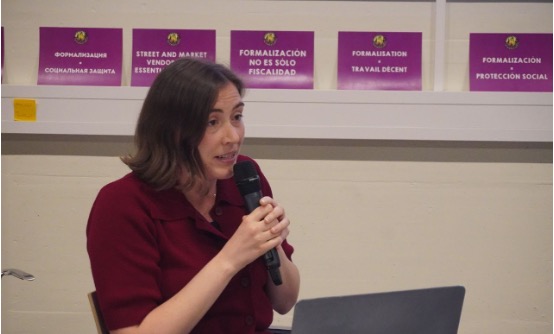
    Early findings from the project were presented by Oksana Abboud (SNI International Coordinator) and Georgia Montague-Nelson (GLI Executive Director). Georgia praised the role of ZCIEA and UTEP in shaping the research programme, highlighting huge potential for replicating the methodology across other countries.

    She also emphasised the value of a participatory approach and for workers and representative organisations to shape and lead worker-focused research. Too often, workers in the informal economy are excluded and ignored, but have valuable knowledge, experience and proposals and can lead the way in transforming their livelihoods and economies – “Nothing for us, without us”!

    [Image: Georgia speaking at the SNI event]

    The full country reports, and a cross-comparative report from the Barometer Project will be launched in the coming months.

    Georgia

    June 30, 2025
    Homepage Post 3, Informal Work, Latest
  • Global Labour Institute at VREF Global Summit

    Global Labour Institute at VREF Global Summit

    Public transport – formal and informal – is a vital service relied upon by millions of people all over the world, strategically important in the economic and social life of cities and central to cutting transport emissions. The sector is also a major employer globally, creating millions of direct and indirect jobs. Across many African cities, public transport reform projects are underway which have significant impacts on informal transport, which many people rely on for their livelihoods. 

    Building on the Global Labour Institute’s (GLI) programme of work focused on the informal transport economy, on 26-28 May, the Global Labour Institute (GLI) attended the Volvo Research and Educational Foundations (VREF) Global Summit, held in Gothenburg, Sweden. The Global Summit brought together 150 people from 30 countries across 3 days to exchange knowledge, ideas and perspectives from research programmes on transport, which included discussion as part of VREF’s programme on ‘Informal and Shared Mobility in Low- and Middle- Income Countries (ISM).’ 

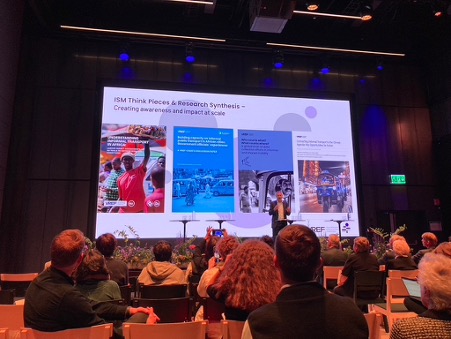
    As part of a breakout session at the Global Summit titled ‘Workers conditions in informal and shared mobility’, Georgia Montague-Nelson (GLI Executive Director) and Alana Dave (International Transportworkers’ Federation (ITF) Urban Transport Director) had the opportunity to co-present our new report: ‘Understanding Informal Transport in Africa: Labour Impact Assessments as Tools to Improve Workers’ Conditions.’ GLI was commissioned by VREF and the ITF to write the research report exploring the potential of labour impact assessments as a means to enhance workers’ conditions in Africa’s informal transport sector, and provides an in-depth conceptual framework to address policy and practical opportunities and challenges. 

    [Image: Georgia & Alana at Global Summit. Credits: VREF]

    Informal transport workers are frequently overlooked when considering the impact of transport reforms on employment and the economy, and rarely included in consultations undertaken by transport authorities. Overcoming structural problems and inequalities requires policies which address the inter-relationship between passenger services and working conditions for the millions of workers who rely on this sector for their livelihoods. Key recommendations and findings from the research paper which were highlighted during the breakout session included:

    • Building trust and confidence to achieve reform that is inclusive of and supported by workers requires consultation and negotiation at the early stages of planning and development of projects, with agreed terms of reference and procedures.
    • Capacity-development for constituent organisations to enable workers and informal employers (owners) to provide education and information to their members, democratically represent their interests, engage in policy development and fully participate in negotiations with transport authorities. 
    • Addressing the immediate concerns of the workforce, including alternatives to the target system, gender discrimination, access to vocational training, harassment and corruption, working conditions, access to affordable capital, and access to social protection 
    • Improving the labour impact assessment methodology by developing a standardised set of research tools and a common framework for data analysis and more detailed evaluation of methodology together with research specialists and other key stakeholders.
    • Mainstreaming the methodology for inclusion in procedures and policies when considering proposals for major public transport projects, which could also include a programme of training for unions, associations, researchers and transport authorities in countries where major transport reform is planned.

    For more information about the paper click here. This paper was also presented and discussed at an online VREF Research Forum. Click here to watch the recording of the forum.

    During the Global Summit, breakout sessions explored a range of different areas of research; including transport accessibility and security, gender equity and transport justice in urban mobility, access and planning; and decolonizing the language of and research about transportation.

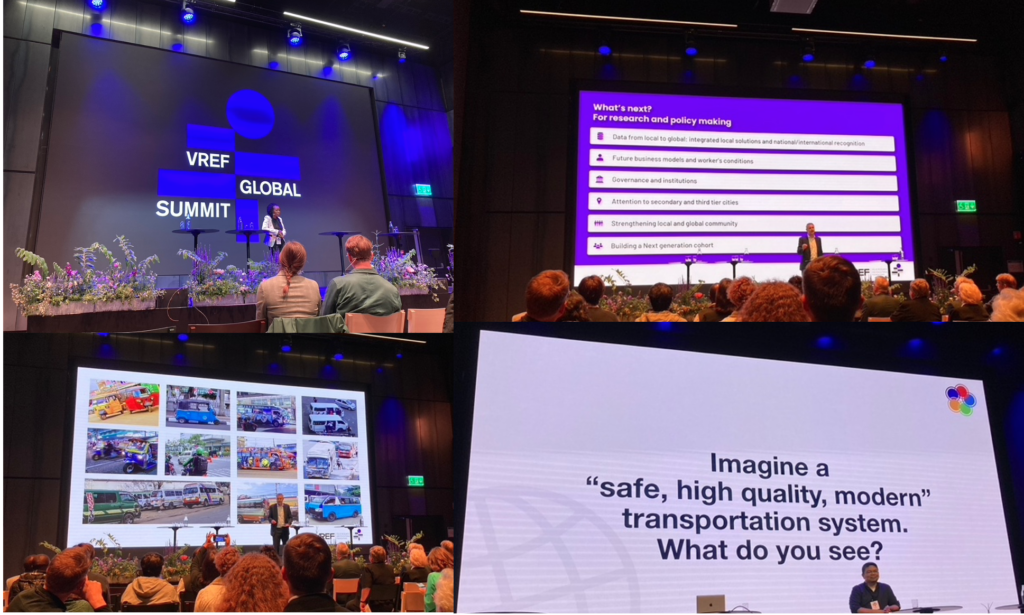
    Plenary sessions also explored ambitions to build future research programmes on mobility and transport in the coming decade, particularly important given the centrality of transforming informal transport to the overall sustainable transport agenda.

    [Image: Plenary Session on ISM, Global Summit]

    Georgia

    June 24, 2025
    Article, Homepage Post 3, Informal Work, Latest
  • Report – Understanding Informal Transport in Africa: Labour Impact Assessments as Tools to Improve Workers’ Conditions

    Report – Understanding Informal Transport in Africa: Labour Impact Assessments as Tools to Improve Workers’ Conditions

    Public transport, formal and informal, is a vital service relied upon by millions of people all over the world. It is strategically important in the economic and social life of cities and is central to cutting transport emissions. The sector is also a major employer globally creating millions of direct and indirect jobs.

    In many African cities, public transport reform projects are underway which have significant impacts on informal transport, the dominant form of public transport. Many people depend on it for their livelihoods, not just drivers or vehicle owners. These other workers are frequently overlooked when considering the impact of reforms on employment and the economy and rarely included in consultations and surveys undertaken by transport authorities.

    Transforming informal transport is central to the overall sustainable transport agenda. Overcoming structural problems and inequalities requires policies which address the inter-relationship between passenger services and working conditions for the millions of workers who rely on this sector for their livelihoods.

    GLI was commissioned by the Volvo Research and Educational Foundations (VREF) and the International Transport Workers’ Federation (ITF) to write a research paper exploring the potential of labour impact assessments as a means to enhance workers’ conditions in Africa’s informal transport sector. Read more about previous labour impact assessments undertaken by GLI here.

    The report ‘Understanding Informal Transport in Africa: Labour Impact Assessments as Tools to Improve Workers’ Conditions‘ explores the potential of labour impact assessments as a means to enhance workers’ conditions in Africa’s informal transport sector – and provides an in-depth conceptual framework to address both the policy and practical opportunities and challenges.

    The report details the use of participatory research methods; defining ‘transport worker’ to include all those directly dependent on informal transport for their livelihoods; building partnerships with local academic institutions; supporting constructive dialogue and negotiation between trade unions and transport authorities and most importantly, building participation by trade unions and workers’ associations representing informal transport workers.

    This report provides a detailed account of how the methodology has been implemented in different local contexts in Africa, the major findings and lessons learned, and provides an in-depth conceptual framework to address both the policy and practical opportunities and challenges.

    The paper was presented and discussed at an online VREF Research Forum titled ‘Unlocking better work conditions in the informal transport sector through labour impact assessments’ on 12th February at 1-2:30 PM GMT.

    Click here to watch the recording of the forum.

    Georgia

    January 21, 2025
    Homepage Post 2, Informal Work, Report
  • Joint GLI-ITF Initiative on Integrating Labour Impact Assessments into Transport Planning

    The International Transport Workers’ Federation (ITF) and Global Labour Institute (GLI) have announced a new initiative that will see the application of labour impact assessments in transport planning around the world. 

    The initiative, announced at the Transforming Transportation conference organised by the World Bank and the WRI Ross Center for Sustainable Cities, is supported by the Volvo Research and Educational Foundations (VREF) as a special study within its research program ‘Informal and Shared Mobility in Low- and Middle-Income Countries. 

    The project will launch an action agenda for the application of Labour Impact Assessment approach and methods in the procedures and policies of city authorities, national governments, multilateral development banks, and other international stakeholders which is set to greatly benefit sector actors, transport planners and policymakers concerned with wider reforms in the public transport sector, including informal transport. 

    A first stage of the initiative will be reviewing and synthesising findings and methodologies from Labour Impact Assessments of Bus Rapid Transit (BRT) projects in Nairobi, Dakar, Kampala, Accra and Abidjan and other initiatives designed to improve the quality, efficiency and decarbonisation of urban public transport in the informal economy. The synthesis of the major findings, lessons learned and recommendations for sector actors, transport planners and policy-makers concerned with wider reforms will then be produced and presented to major stakeholders. 

    The labour impact assessments include participatory research methods, innovative research tools, a broad and inclusive definition of ‘transport worker’ to include all those directly dependent on informal transport for their livelihoods, partnership with local academic institutions, and support for constructive dialogue and engagement between trade unions and transport authorities. 

    This initiative is another crucial step in adding workers’ voices to the changes in public transport and ensuring that workers’ livelihoods are protected and improved moving forward. 

    Click here to read the full press release.

    Click here for more information about GLI’s work on informal transport.

    Georgia

    March 22, 2024
    Article, Informal Work, Latest
    global, Informal Transport, ITF
  • Transport workers uniting along the Belt & Road

    Series: Labour Perspectives on China #6

    – Sean Sayer

    Transport workers move the world. Trade and travel cannot function without us. This means that transport workers are some of the first to be impacted when governments or companies invest in and change the way the world moves and trades.

    Waves of international investment in transport have created millions of good jobs throughout recent history. But we have also seen how this overseas investment has been used to undermine our rights, pay and conditions. The Belt & Road Initiative (BRI) – China’s US$1 trillion overseas infrastructure development project – is one of the latest attempts to change how the world trades. What does this mean for transport workers?

    In 2022, trade unions affiliated with the International Transport Workers’ Federation (ITF) from thirty-eight countries and from every continent met in Manila to try to answer this question.

    In context

    First, it is important to put the BRI in context. The American Enterprise Institute’s China Global Investment Tracker estimates that between 2013 and 2020, the BRI invested US$400 billion in overseas transport infrastructure, the World Bank Group invested UD$178 billion, and the Asian Development Bank invested US$83 billion. In 2021, Chinese outward foreign-direct investment represented less than 7% of the global total. The US (23%), Germany (8%) and Japan (8%) all spent more. So, the first decision by our affiliates was to understand the opportunities and challenges posed by all types of international investment, not just BRI.

    Transport workers around the world have seen how all types of international investment pose risks to recipient economies, societies, communities and workplaces. For example, International Monetary Fund and World Bank loans to countries including Cameroon, Ghana, Nicaragua and Pakistan required ‘structural adjustment’ programmes which demanded that governments privatise or dramatically cut spending on public services, often including transport. When the World Bank disperses aid to a low-income country, the amount of cash in offshore accounts controlled by the country’s elites tends to increase on average by about 7.5%.

    The World Bank (2018) estimates that, if completed, BRI transport projects could reduce travel times along economic corridors by 12%, increase trade between 2.7% and 9.7%, increase income by up to 3.4% and lift 7.6 million people from extreme poverty. BRI is also estimated to create thousands of transport and supply chain jobs in most recipient countries, including Kazakhstan (200,000 jobs), Kenya (more than 60,000), Mongolia (50,000), and Pakistan (more than 60,000).

    In 2019, China signed a series of agreements relating to the BRI with the ILO and three Chinese ministries. These agreements (1) promote decent work, social justice and a ‘human-centred future of work’; (2) support occupational safety; and (3) promote the effective implementation of the ILO’s Maritime Labour Convention along the BRI. This could signal that the Chinese ministries acknowledge that international labour rights and laws apply to workers in the countries they are investing in and building transport infrastructure in, as well as to the cross-border workers who are working between them.

    However, Chinese project-based, migrant workers tend to make up a significant proportion of those working in BRI investments. Often, local labour laws are not applied to these non-resident workforces. Many of these workers are reported to suffer from egregious human rights violations. For example, in Serbia, the local labour laws were suspended for Chinese nationals working there. In the Serbian Zijin Mining Group Co. copper mine, Chinese employees worked 12-hour days, were forced to hand passports over to employers, and had little to no health and safety protection, including during the COVID-19 pandemic. In the Linglong Tyre Co. factory in Serbia, Chinese workers experienced poor housing conditions, no access to medical services, issues with or absences of wages, and were again forced to give their passports to employers, leading to allegations of human trafficking and modern slavery.

    Labour rights abuses and divisions

    Furthermore, local workers are often subjected to human rights and labour rights abuses. For example, working conditions in the construction of the new Phnom Penh International Airport show systemic human rights abuses. Imported Chinese workers are paid US$50 to US$70 a day, while local Cambodians are paid US$7.5 to US$15 a day, and women are paid less than men. Accommodation is in local temporary settlements, where workers’ children live on site, with no food, education, healthcare, water or electricity provided. There is minimal provision of sanitation facilities and personal protective equipment, and uneven and inconsistent provision of compensation for health and safety failures.

    In Mongolia, truck drivers reported that BRI investment into infrastructure built for the extraction and transport of coal had put truck drivers and railway workers in direct competition with new groups of informal, cross-border workers and employment models. Furthermore, the development of rail and logistics infrastructure continues to threaten a shift away from unionised labour in trucking.

    In Pakistan, BRI projects avoid collective bargaining by avoiding railways, instead focusing on trucking. Where collective bargaining cannot be avoided, alliances between Chinese interests and local elites are challenging the industrial models and labour movement.

    In Kenya, the flagship US$3.6 billion Mombasa-Nairobi Standard Gauge Railway, and the special economic zones (SEZs) around the connected ports and logistics centres, are estimated to employ around 60 000 workers. However, rail exclusively moves the freight coming in and out of the SEZs, bypassing the better-unionised truck drivers and collective bargaining.

    Transport needs nearly US$50 trillion of investment by 2040. Transport workers around the world recognise that to create decent work, resilient supply chains, a fair economy, gender equity, climate justice, and a more sustainable transport and development model, we must welcome spending on transport infrastructure. However, this financial commitment must be conditional on the guarantee of fundamental human rights, including freedom of association, the right to collective bargaining, the right to strike, and all our fundamental labour rights.

    What international investment should guarantee

    Therefore, transport workers’ representatives in Manila agreed that international investment must be:

    Safe – occupational health and safety is a fundamental right at work. Applicable laws and regulations must be respected and enforced to protect to all workers, regardless of their gender, occupation, terms of employment and contractual status.

    Democratic – local and international laws, regulations and democratic processes must be respected. Trade unions must be treated as equal partners by governments and employers in collective bargaining. Critical infrastructure must be owned by, and operated for the people it serves.

    Fair – secure, permanent, and formal employment must be offered to all workers equally, regardless of their ethnicity, nationality, religion, gender or background, and respected by employers. Governments and employers must ensure that informal work and other non-standard forms of employment are not used to deny workers their rights.

    Open – workers must be included in the negotiation and agreement of investment. No governments should sign deals in secret. Full transparency and accountability of negotiations of contracts and trade deals must be a minimum standard for international investment. Trade unions must be recognised as effective and critical partners for ensuring transparency and accountability at all levels.

    Skills-based – local workers must be trained and skilled to construct, operate and maintain transport infrastructure built using international investment. The ITF and its affiliates oppose any exploitation of non-resident workers and unfair labour competition.

    Fundamentally, BRI and other forms of international investment are connecting workers in new, exciting ways. In Manila, we witnessed the birth of a new family of transport workers connected by patterns of international investment, born of solidarity, unity and understanding.

    Trade unions representing transport workers in Central and Southeastern Asia are cooperating with those in Africa and Europe to develop organising models for third-country nationals. Transport workers are connecting with construction workers, learning from their experiences working under Chinese and overseas employers or investment. Governments seeking to ensure transparency and accountability of projects stemming from international investment are looking to trade unions for assistance. New human rights due diligence laws that require government and companies to check and fix their domestic and overseas supply chains are giving trade unions a legally recognised role in upholding labour rights in the BRI and global trade. To do this, we must work across borders and organise some of the most exploited and vulnerable workers in supply chains that are adjusting to international investment.

    By focusing on workplace rights, experiences and solidarity, trade unions are building a new future amid profound change. Supply chains may ebb and flow – becoming more local, regional or again global – but the solidarity among transport workers has always been, and will always be, global. This is where real workers’ power is built today, tomorrow and forever.


    Sean Sayer is a policy advisor at the International Transport Workers’ Federation (ITF), based in London, UK. He coordinates the ITF’s supply chain programme, working with transport workers and their trade unions across the world.


    Read our other articles from Global Labour Column here.

    Fionna McAndrew

    February 20, 2024
    Article, Informal Work, Latest
    China, Global Labour Column, informal transport workers
  • Abidjan Bus Rapid Transit and Metro: Labour Impact Assessment 

    Abidjan faces major problems in passenger transport, most of which is in the informal economy. Services are frequently slow and unreliable, roads are congested and poorly maintained. Most services are provided by numerous gbâkâs (minibuses) and wôrowôros (taxis), mostly old environmentally harmful vehicles operating on a target (‘la recette’) system that encourages dangerously long working hours and on-street competition between drivers.

    Bus Rapid Transit (BRT) and Metro systems offer the prospect of more efficient, cleaner, and faster passenger transport. At the same time, they potentially threaten the livelihoods of thousands of people who currently depend on the employment provided by the informal transport industry.

    This labour impact assessment attempts to build a comprehensive understanding of the composition and characteristics of the workforce, the issues that workers face in their day-to-day work, and detailed illustrations of the microeconomy, as well as an attempt to estimate the number of livelihoods in the transport industry at risk or to be created through the introduction of BRT and Metro.

    This report of research was commissioned by the International Transport Workers’ Federation (ITF) from Global Labour Institute (GLI) and Université Alassane Ouattara (Côte d’Ivoire).

    Click here to read this report in English.

    Click here to read this report in French. 


    Read this report via Academia.edu here.


    Georgia

    November 17, 2023
    Informal Work, Latest, Report
    Abidjan, Côte d’Ivoire, Informal Transpor Workers, ITF
  • Informal Transport Workers in Accra: Livelihoods, Organisation and Issues

    Accra’s passenger transport system is dominated by a large paratransit industry, primarily informally operated buses and minibuses (“trotros”) and motorcycle taxis (“okada”) and taxis. In common with most major African cities, Accra’s streets are highly congested. The paratransit industry has also become notorious for inefficiency, violent criminality, pollution and corruption.

    On the other hand, it offers cheap transport essential for the more than four million commuters and is highly flexible and responsive. It also informally employs hundreds of thousands of people in a city where earnings are poor and where employment is scarce.

    The transformation of Accra’s informal public transport into a more efficient, less congested and more environmentally sustainable system is a critical issue for national and local government in Ghana.

    This report analyses the paratransit industry in the Greater Accra Metropolitan Area (GAMA) from a socio-economic perspective. It provides a description of the informal transport workforce in Accra, including those working in the trotro minibus, taxi and okada (motorcycle taxi) industries. It examines workforce characteristics, livelihoods and employment relationships, provides in-depth economic profiles of operations, identifies key issues, and considers options for formalisation.

    The main objective is to support a public transport reform and streamlining of the highly fragmented paratransit sector. The findings, analyses and recommendations are meant to support a constructive engagement with stakeholders

    The report is based on research undertaken by GLI in 2021 in partnership with the University of Cape Coast and transport trade unions in Ghana, as part of a broader project with Transitec Consulting Engineers and Organisation Development Africa (ODA), commissioned by the Ghana Urban Mobility and Accessibility Project (GUMAP) of the Ministry of Local Government and Rural Development.

    Click here to read this report.

    Georgia

    November 3, 2023
    Informal Work, Latest, Report
    Accra, Ghana, informal transport workers, University of Cape Coast

CONTACT

gli-uk@global-labour.net

Global Labour Institute
(GLI Network Ltd)
535 Royal Exchange
Manchester
M2 7EN
UK

OUR SITE

Home

About Us

Publications

Issues

Trade Union Education

GLI History Project

Latest

KEEP IN TOUCH

  • X
  • LinkedIn
  • Facebook

The GLI Network Limited is a limited company registered in England and Wales, company number 07378368

GLI Manchester is part of the GLI Network

Privacy Policy

Site created by greenh & hosted by Webarchitects Co-operative