Public transport – formal and informal – is a vital service relied upon by millions of people all over the world, strategically important in the economic and social life of cities and central to cutting transport emissions. The sector is also a major employer globally, creating millions of direct and indirect jobs. Across many African cities, public transport reform projects are underway which have significant impacts on informal transport, which many people rely on for their livelihoods.
Building on the Global Labour Institute’s (GLI) programme of work focused on the informal transport economy, on 26-28 May, the Global Labour Institute (GLI) attended the Volvo Research and Educational Foundations (VREF) Global Summit, held in Gothenburg, Sweden. The Global Summit brought together 150 people from 30 countries across 3 days to exchange knowledge, ideas and perspectives from research programmes on transport, which included discussion as part of VREF’s programme on ‘Informal and Shared Mobility in Low- and Middle- Income Countries (ISM).’
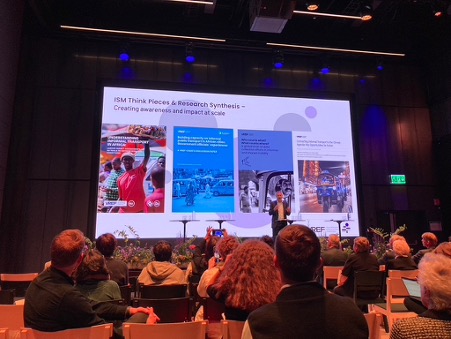
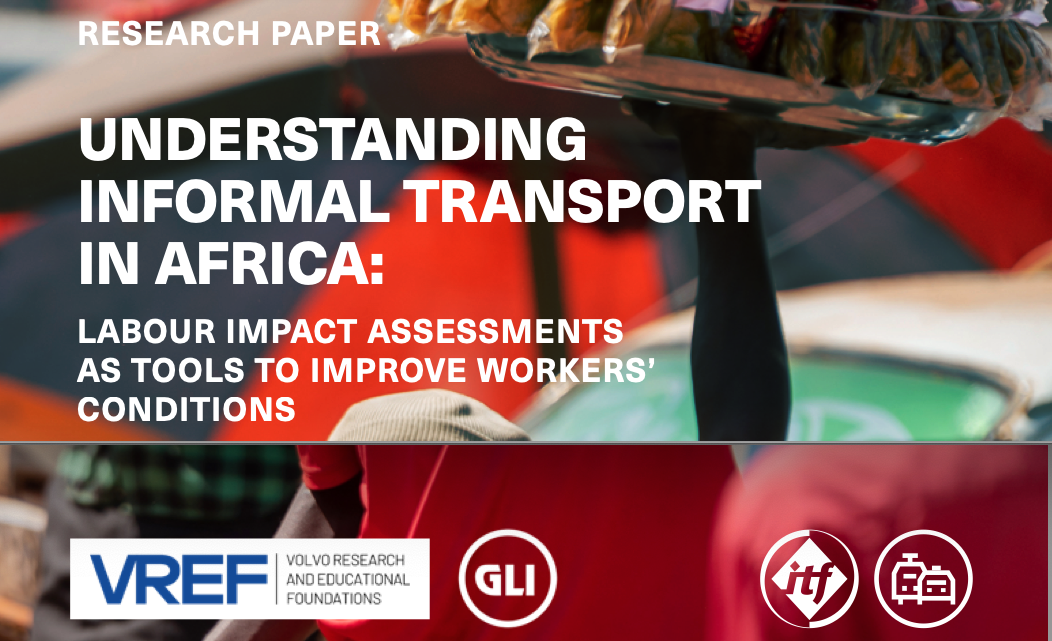
As part of a breakout session at the Global Summit titled ‘Workers conditions in informal and shared mobility’, Georgia Montague-Nelson (GLI Executive Director) and Alana Dave (International Transportworkers’ Federation (ITF) Urban Transport Director) had the opportunity to co-present our new report: ‘Understanding Informal Transport in Africa: Labour Impact Assessments as Tools to Improve Workers’ Conditions.’ GLI was commissioned by VREF and the ITF to write the research report exploring the potential of labour impact assessments as a means to enhance workers’ conditions in Africa’s informal transport sector, and provides an in-depth conceptual framework to address policy and practical opportunities and challenges.
[Image: Georgia & Alana at Global Summit. Credits: VREF]

Informal transport workers are frequently overlooked when considering the impact of transport reforms on employment and the economy, and rarely included in consultations undertaken by transport authorities. Overcoming structural problems and inequalities requires policies which address the inter-relationship between passenger services and working conditions for the millions of workers who rely on this sector for their livelihoods. Key recommendations and findings from the research paper which were highlighted during the breakout session included:
- Building trust and confidence to achieve reform that is inclusive of and supported by workers requires consultation and negotiation at the early stages of planning and development of projects, with agreed terms of reference and procedures.
- Capacity-development for constituent organisations to enable workers and informal employers (owners) to provide education and information to their members, democratically represent their interests, engage in policy development and fully participate in negotiations with transport authorities.
- Addressing the immediate concerns of the workforce, including alternatives to the target system, gender discrimination, access to vocational training, harassment and corruption, working conditions, access to affordable capital, and access to social protection
- Improving the labour impact assessment methodology by developing a standardised set of research tools and a common framework for data analysis and more detailed evaluation of methodology together with research specialists and other key stakeholders.
- Mainstreaming the methodology for inclusion in procedures and policies when considering proposals for major public transport projects, which could also include a programme of training for unions, associations, researchers and transport authorities in countries where major transport reform is planned.
For more information about the paper click here. This paper was also presented and discussed at an online VREF Research Forum. Click here to watch the recording of the forum.
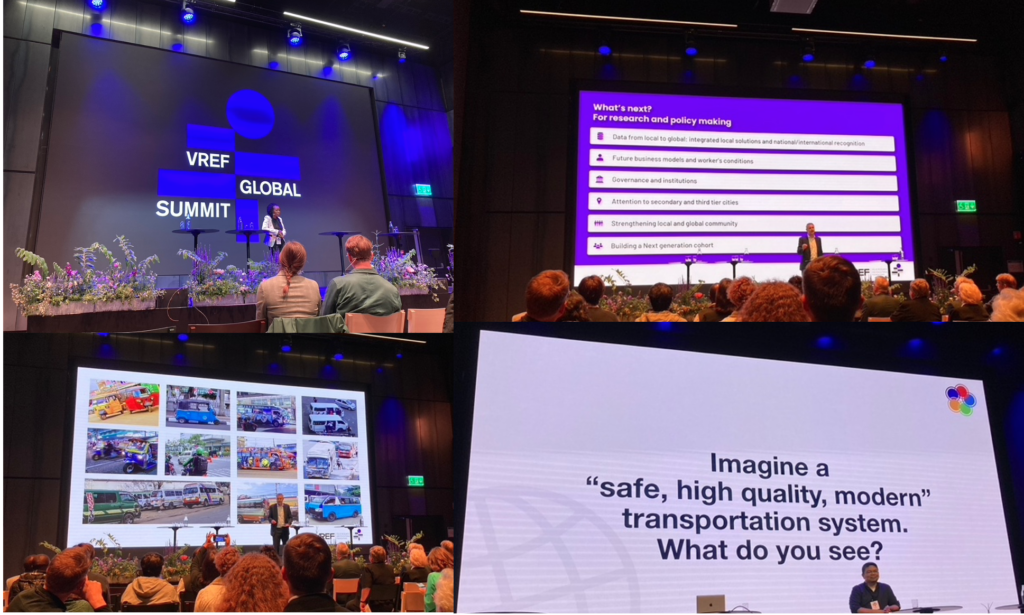
During the Global Summit, breakout sessions explored a range of different areas of research; including transport accessibility and security, gender equity and transport justice in urban mobility, access and planning; and decolonizing the language of and research about transportation.
Plenary sessions also explored ambitions to build future research programmes on mobility and transport in the coming decade, particularly important given the centrality of transforming informal transport to the overall sustainable transport agenda.
[Image: Plenary Session on ISM, Global Summit]