
Skip to content

Global Labour Institute

  • About Us
    • Our Team
    • Contact Us
    • The Global Labour Institute Network
    • Key Partners
  • Publications
  • Issues
    • Informal Work
    • Gender and Equalities
    • Climate Crisis
  • Trade Union Education
    • GLI International Summer School
      • International Summer School 2016
      • International Summer School 2015
      • International Summer School 2014
      • International Summer School 2013
      • International Summer School 2012
  • The GLI History Project
  • Latest
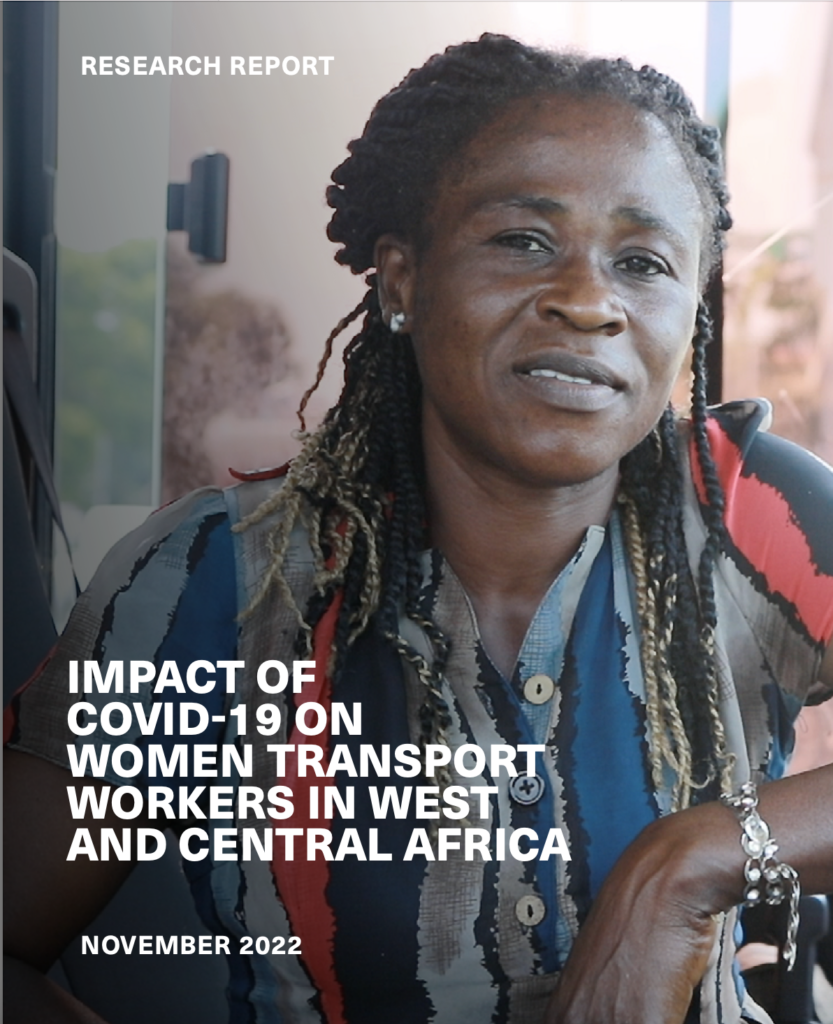
  • ITF Study: Impact of COVID-19 on Women Transport Workers

    The COVID-19 pandemic has caused mass social and economic disruption across the world. All workers have been affected by the pandemic. But the negative impacts of the crisis are falling disproportionately on women workers. Women workers have suffered a disproportionate loss of livelihoods, whilst also having to bear additional burdens of unpaid caring and domestic responsibilities. The impacts of the pandemic have also increased exposure to violence and harassment for women workers and studies have shown that reports of domestic violence have skyrocketed during the pandemic.

    As part of the 16 Days of Activism against Gender-Based Violence, the International Transportworkers Federation (ITF) has launched a report which exposes how women transport workers were hit hardest by the COVID-19 pandemic – both at work and at home.

    GLI Manchester was commissioned by the ITF to produce this research study to explore the impact that the COVID-19 pandemic has had on women transport workers, including in increasing exposure to violence and harassment, and to assess the long-term impact of the crisis on women

    The research set out to gather evidence to build the case about the link between the pandemic and violence and harassment against women transport workers, to provide arguments for unions to secure a gender-responsive pandemic recovery, and to enable unions to use C190 as a tool to build movements to address violence and harassment. It identified three main impacts from the COVID-19 pandemic:

    • Impacts on employment and working conditions
    • Impacts on violence and harassment
    • Impacts on action in the trade union movement

    The research also identified several recommendations for how trade unions can work with governments and employers to address the impacts of the pandemic on women transport workers, and to integrate this into the COVID-19 response and recovery. 

    The study draws together research from seven ITF C190 project countries across West and Central Africa. Study participants included women workers, union members and leaders in both the informal and formal transport economy across four different transport sectors: aviation, road (passenger and freight), maritime and rail (passenger and freight).
    Click here to read the research report in English.

    Georgia

    November 29, 2022
    Latest
    C190, genderbasedviolence, genderequality, transportworkers, violenceandharassment
  • PSI Guide on Rebuilding the Social Organisation of Care

    Care is the activities that are needed to satisfy our basic needs to exist. It is the glue that holds societies together and enables economies to function. It is essential for the existence and the reproduction of societies.

    In many countries, caring for the young, elderly, and vulnerable has long been part of social protection and welfare institutions. But years of austerity, neoliberal reforms, and privatisation have resulted in a care system that is failing to provide for the needs of society. It also means that care workers face low wages and exploitation at work.

    Across much of the Global South, social care systems are virtually non-existent, and the State is largely absent from its provision. There is also limited or extremely expensive private provision of social care. This means that most care work, including social care, takes place in families and communities and is largely provided by women.

    In response to the care crisis, Public Services International (PSI) has focused on shifting approaches to care away from the dominant approach (the ‘care economy’) to the social organisation of care (SOC). PSI is calling for action to ‘rebuild the social organisation of care’ to a new model that puts caring for people over caring for profits. PSI has called for 5Rs as a way forward to fix the care crisis:

    1. Recognise the social and economic value of care work (paid or unpaid) and the human right to care.
    2. Reward, remunerate and represent care work and care workers with professionalised work, equal pay for work of equal value, adequate pensions, comprehensive social protection, healthy and safe working conditions, strong representation, unionisation, and collective bargaining and social dialogue in line with the ILO Decent Work Agenda.
    3. Reduce the burden of unpaid care work on women.
    4. Redistribute care work within households, among all workers, eliminating the sexual division of labour, and between households and State.
    5. Reclaim the public nature of care services and restore the duty and the primary responsibility of the State to provide public care services and develop care systems that transform gender relations and women’s lives – including by financing State’s capacity to invest through fair and progressive taxation and ensuring internationally equal taxing rights of nation States. 

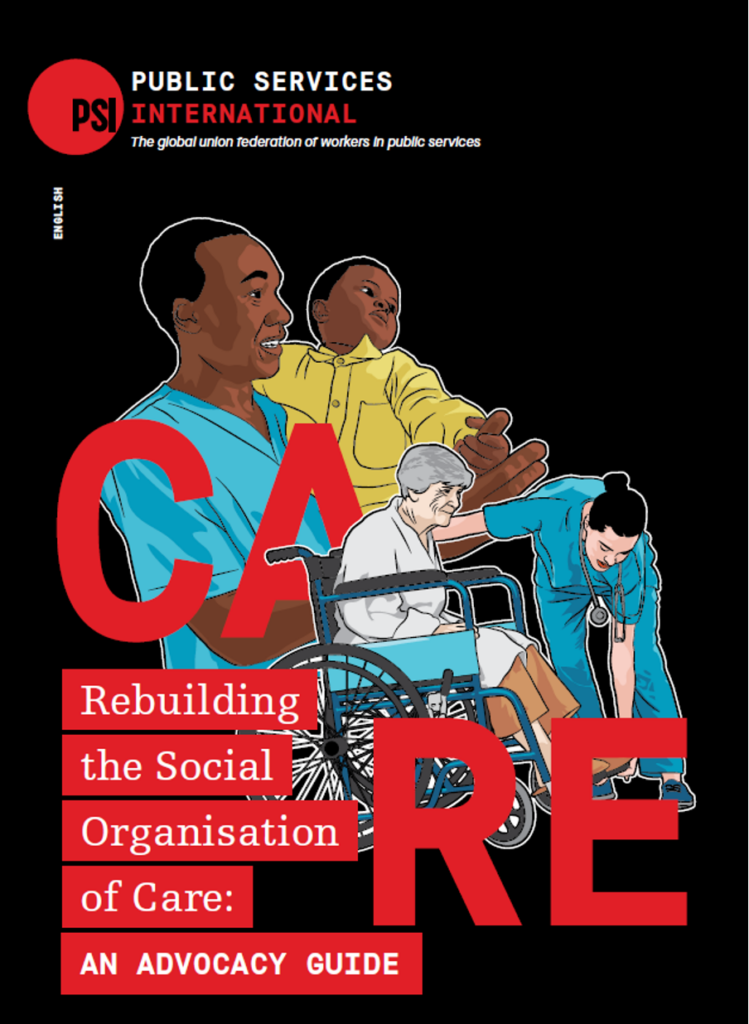
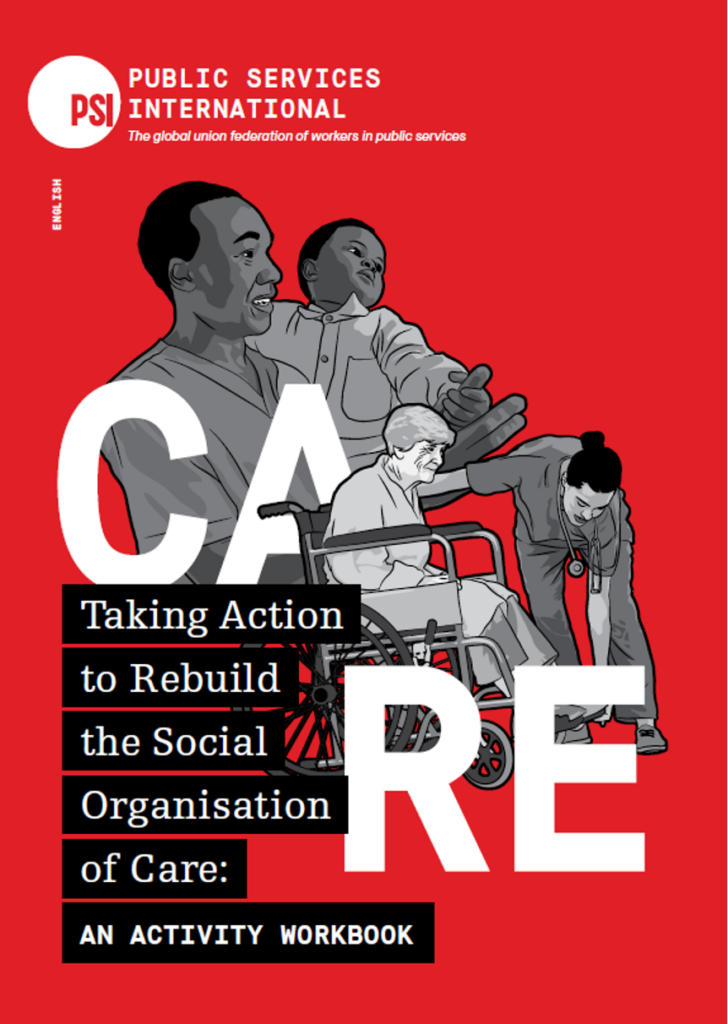
    GLI Manchester was commissioned by PSI to produce a guide on Rebuilding the Social Organisation of Care. The guide includes both an Advocacy Guide and an Activity Workbook that aim to assist trade unions and women workers around the world to make PSI’s Care Manifesto an instrument of trade union political action at the local level, to rebuild the social organisation of care for a new model that puts caring for people over caring for profits.

    The Advocacy Guide includes information about the key issues facing paid and unpaid care workers and key demands – organised around the 5Rs – to support unions when campaigning around the human right to care and care as a public good. It also includes examples of union action, relevant international standards and further resources that might be useful.

    The Activity Workbook contains training materials to strengthen understanding of the key issues and build trade union capacity – particularly amongst women – to enable unions to develop practical action. 

    Click here to read the Advocacy Guide in English. 

    Click here to read the Advocacy Guide in Spanish. 

    Click here to read the Activity Workbook in English. 

    Click here to read the Activity Workbook in Spanish. 

    The guide is also available as a digital publication on the PSI website. Click here to access the digital publication.

    Georgia

    November 9, 2022
    Latest
    care, genderequality, PSI, rebuildingthesocialorganisationofcare, RSOC, unions

CONTACT

gli-uk@global-labour.net

Global Labour Institute
(GLI Network Ltd)
535 Royal Exchange
Manchester
M2 7EN
UK

OUR SITE

Home

About Us

Publications

Issues

Trade Union Education

GLI History Project

Latest

KEEP IN TOUCH

  • X
  • LinkedIn
  • Facebook

The GLI Network Limited is a limited company registered in England and Wales, company number 07378368

GLI Manchester is part of the GLI Network

Privacy Policy

Site created by greenh & hosted by Webarchitects Co-operative