Global Labour Institute

  • About Us
    • Our Team
    • Contact Us
    • The Global Labour Institute Network
    • Key Partners
  • Publications
  • Issues
    • Informal Work
    • Gender and Equalities
    • Climate Crisis
  • Trade Union Education
    • GLI International Summer School
      • International Summer School 2016
      • International Summer School 2015
      • International Summer School 2014
      • International Summer School 2013
      • International Summer School 2012
  • The GLI History Project
  • Latest
  • TUED Bulletin 141 – Indonesia: TUED Supports Unions in Constitutional Court Battle to Stop “JETP” Energy Privatisation

    Broad coalition organises to defend public energy clause in Indonesian Constitution, oppose pro-privatisation electricity reforms.
    Following yesterday’s elections in Indonesia, we turn to the country’s energy sector and the Indonesian labor movement’s fight to defend public energy against the threat posed by the “privatise to decarbonise” agenda reflected in the Just Energy Transition Partnership (JETP) between the rich countries and the Indonesian government.  

    TUED and the Indonesian Energy Unions 

    In mid-January 2024, TUED supported a broad coalition of trade unions, academics and public figures that petitioned Indonesia’s Constitutional Court to declare unconstitutional the electricity sector reform provisions in Law Number 6 of 2023.  

    Known as GEKANAS, the coalition’s petition reflected concerns that the new law would lead to the “unbundling” of PLN, the public power utility, and increase the role of the for-profit independent power producers (IPPs.) The coalition’s effort is supported by power sector unions, namely:  

    • PT Perusahaan Listrik Negara (Persero) or SP PLN
    • Indonesia Power or PP IP, 
    • The PT Pembangkitan Jawa Bali

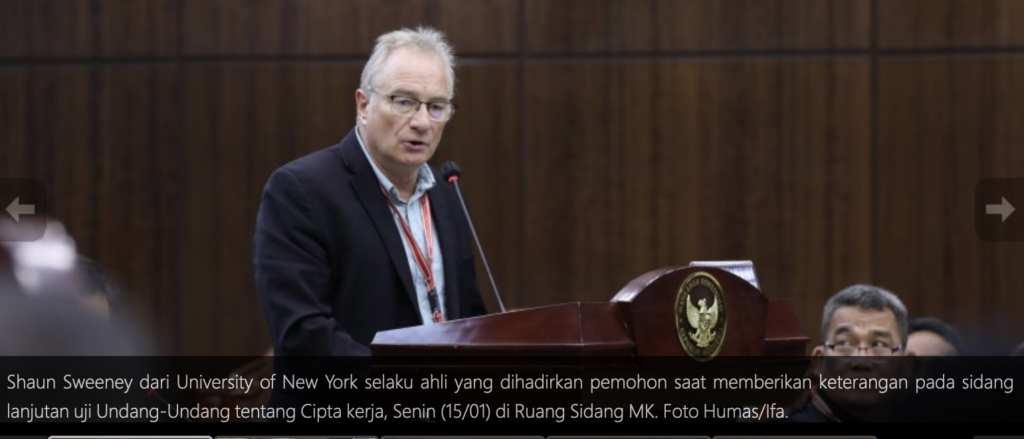
    Article 33 of Indonesia’s Constitution states that the country’s vital resources should be controlled by the Indonesian state. Appearing as an expert witness before the Court in Jakarta, TUED coordinator Sean Sweeney drew attention to the “privatise to decarbonise” agenda embedded in the Just Energy Transition Partnership (JETP) between the rich countries and Indonesia. This, suggested Sweeney, lies behind the energy provisions of Law Number 6 which, he said, would “eviscerate Article 33.” A video of Sweeney’s intervention Constitutional Court is available here.

    Strings Attached 
    Sweeney told the court that JETP financing from rich countries comes with strings attached, as seen in the South African case. Announced in November 2021, the JETP with South Africa, the first of its kind, set the tone. It states that financing would be contingent upon unbundling of the public utility, Eskom. The JETP statement between the rich countries and the Government of Indonesia called for a “clear strategy for private sector engagement,” detailing “policy reforms necessary to address any regulatory barriers.”  

    In November 2022, at the G20 Summit in Bali, a group of developed countries—led by the US and Japan—pledged to mobilize US$20 billion over the next 3-5 years to accelerate Indonesia’s energy transition through early retirement of coal power plants and deployment of renewable energy. Currently, the public utility PLN generates about 65% of the country’s electricity, down from 92% in 1990. The presence of IPPs has grown to 35% of generation. The JETP is designed to accelerate the growth of the for-profit IPPs. 

    In Indonesia’s case, the utility PLN is encouraging the growth of IPPs as seen in the PLN’s Electricity Power Supply Business Plan (RUPTL), 2021–2030, from October 2021. The World Bank and its regional Asia Development Bank (ADB) “will simultaneously target pioneering large-scale RE and storage (RE+Storage) projects led by the private sector that will aim to serve demand both in grid-connected and captive power contexts.” 
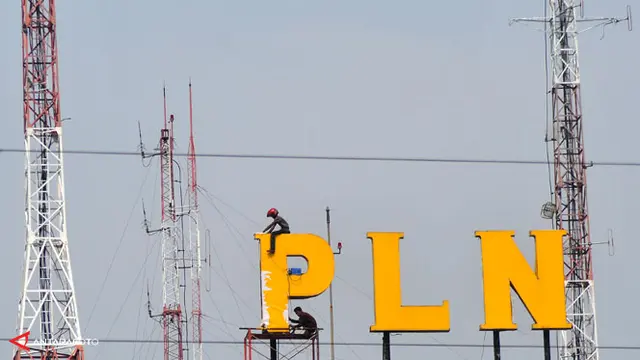
    Why would PLN wish to further undermine its position in the power sector? The RUPTL notes that the World Bank and ADB is “preparing a results-based lending (RBL) program to support PLN in accelerating Indonesia’s clean energy transition.”  Periodic loan disbursements will be contingent upon “satisfactory performance.” The ADB partnership with the Government of Indonesia notes that “ADB support will center on policy reforms toward stronger energy sector governance, clean energy and energy efficiency, and private sector participation, while the investment focus will be on sustainable power generation, power transmission systems, and electricity grids.”

    The JETP, Article 33, and Private Sector Participation 
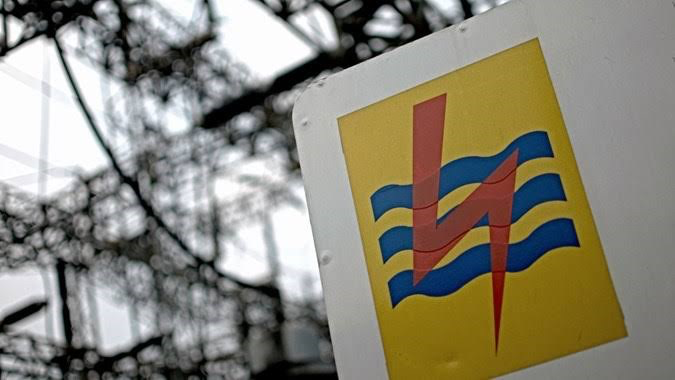
    The designers of the JETP with Indonesia do not want to explicitly confront Article 33, said Sweeney, but the innocuous language of Law No 6, allows for private sector “participation” in the electricity system will allow this objective to be achieved via the “back door.” Read the official court press release on Sweeney’s intervention. 

    In his written submission to the Court, Sweeney stated that by 2030, PLN’s role will be reduced to being mainly a buyer of electricity (as the “off-taker”) from privately owned generators. This would mean the state would no longer have control over its electricity system. 

    Released in late November 2023, the Indonesia JETP Comprehensive Investment and Policy Plan, explicitly states: “A PPA [power purchase agreement] should not be treated by its contracting parties as a procurement of a ‘project’ or an ‘asset’ that PLN would eventually own but rather as a procurement of electrons.” In other words, electricity will no longer be seen as a public good generated for human development and nation-building; rather, electricity will become a commodity that PLN is legally obligated to purchase from private companies.

    Sweeney’s submission also provided data that pointed to the failure of the “blended finance” model that informs the JETP. The $20 billion dollar JETP package would add to the country’s debt obligations while leaving Indonesia to find an additional $97 billion to finance the transition away from coal. 

    Public Pathway as an Alternative to JETPs
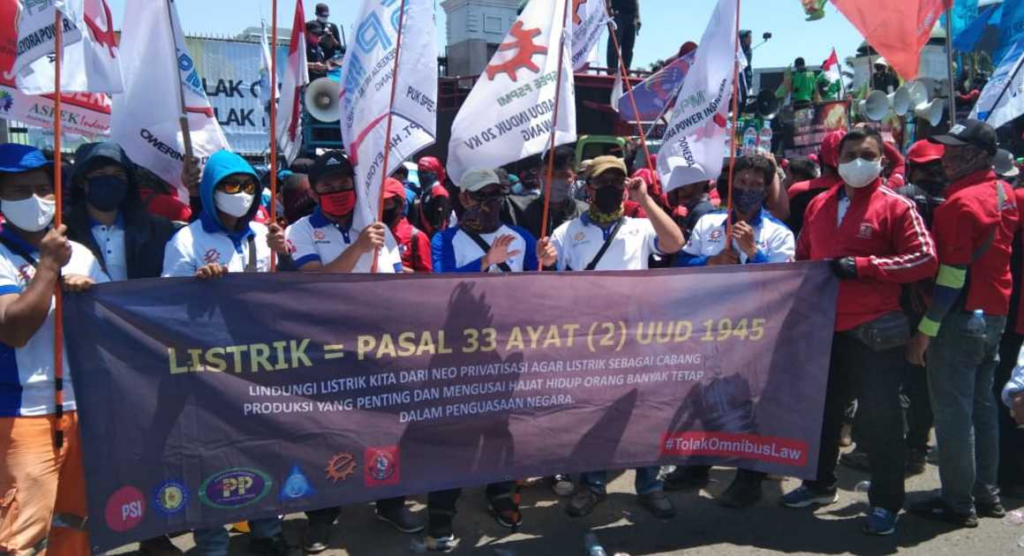
    Sweeney then explained that Indonesia and other coal-dependent countries in the Global South could pursue an alternative “public pathway” approach where state control and public financing can be the drivers of economy wide decarbonisation based on prudent energy planning within a framework of global public goods.
     
    The need for this policy shift is made evident in the data on global energy trends, he said. These trends indicate that we are witnessing an energy transition, but an energy expansion. Fossil fuel use is rising, not falling. Greenhouse gas emissions (GHGs) also continue to rise, making the Paris Agreement targets almost meaningless in the short term.

    Indonesian Trade Unions Fight Back
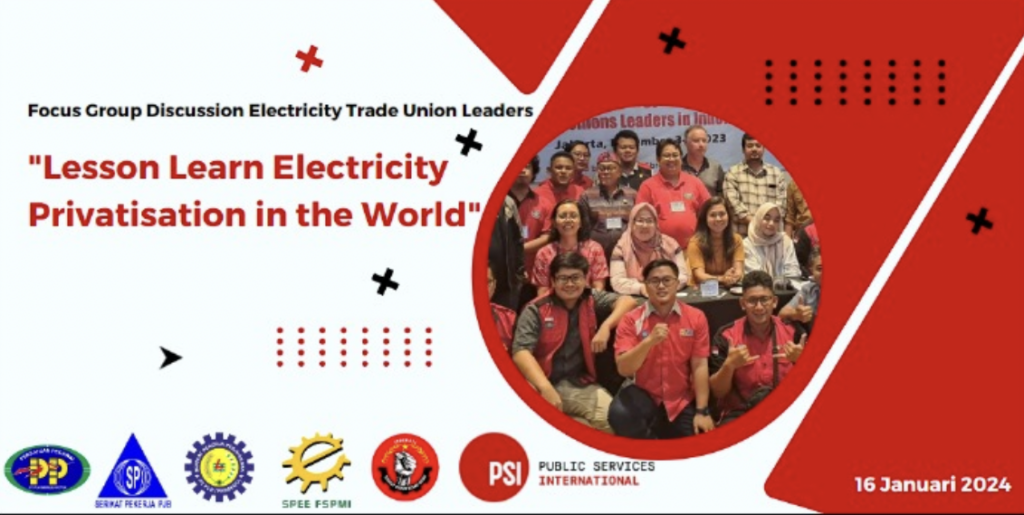
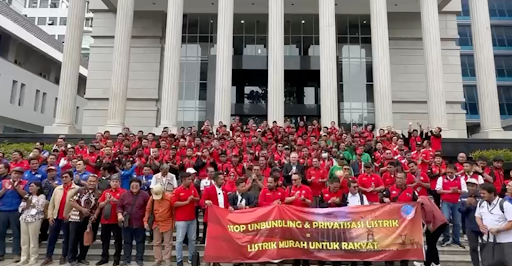
    The Indonesian labor movement and its allies continue to organize in defense of Article 33 and PLN’s role as the principal energy provider. 

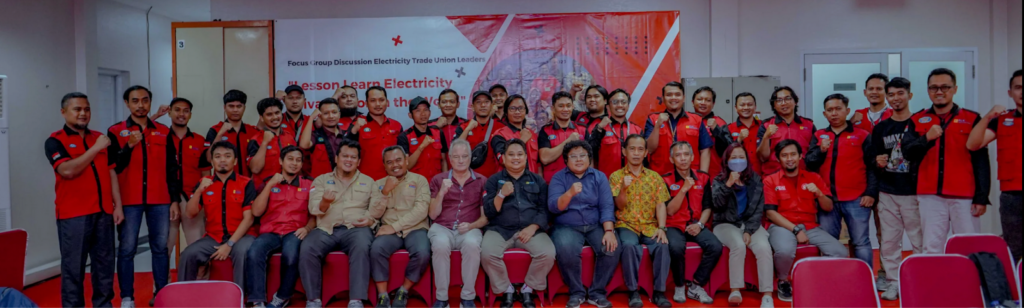
    On January 17th, roughly 60 union leaders gathered for a discussion on “ Lessons Learned from the Privatisation of Electricity around the World” – and the Public Pathway alternative. 

    Said Andy Wijaya, the General Secretary of Persatuan Pegawai Indonesia Power: “Once I was told by a Parliament member that if a State-Owned Company is privatized, the wage would increase sevenfold. I said that currently I am working in PT PLN, and I am paid. But there is no guarantee that my children, my family will be able to get a job at PT PLN that is also well-paid, just like me. Especially if PLN is privatized. I will feel very guilty if in the future, our children will have to pay expensive electricity price because PLN is privatized and I don’t do anything to stop it.” 

    “Public sector unions play a pivotal role for social justice and public energy that improves people’s lives. Therefore, we need to stay strong in defending public services with pure vigour and use all our powers as unions to keep public energy and services in the hands of the public. Our work with affiliates in Indonesia is to fight againts privatisations and towards a Public Pathway alternative that democratises public services,” said Indah Budiarti, Project Coordinator of the PSI Southeast Asia Office and based in Indonesia. Read Budiarti’s insightful article, “Analyzing the Dynamics of Indonesian Energy: Between Government’s Subsidy, Privatization, and Ecological Sustainability”.

    In solidarity,
    The TUED Team


    Trade Unions for Energy Democracy (TUED) is a global, multi-sector trade union initiative to advance democratic direction and control of energy in a way that promotes solutions to the climate crisis, energy poverty, the degradation of both land and people, and responds to the attacks on workers’ rights and protections. TUED is part of the Global Labour Institute Network.

    Fionna McAndrew

    February 20, 2024
    Article, Climate, Latest
    Energy Democracy, Indonesia, TUED
  • TUED Bulletin 137 – Updates on TUED South & Discussion on Position Paper “Reclaim & Restore” Public Utilities to Fight Energy Poverty

    RSVP and join TUED on Wednesday, August 16th, 0800 – 0930 Eastern US to discuss: Reclaim and Restore: Preparing a Public Pathway to Address Energy Poverty and Energy Transition in sub-Saharan Africa.

    Reclaim and Restore

    In mid-May 2023, unions from 12 countries in sub-Saharan Africa (SSA) came together in Johannesburg to lay the groundwork for a public pathway approach to addressing the challenge of energy poverty in the region.  

    Convened by TUED South, the 3-day meeting discussed a draft position paper that brings to light the abject failure of neoliberal approaches to addressing energy poverty in the region. 

    Focusing on the World Bank, the paper describes how the Bank’s structural adjustment agenda of the 1990s targeted public utilities and redirected financial support to for-profit independent power producers (IPPs). The results have been devastating. Today half of the region’s population (roughly 600 million people) have no electricity, 70% in rural regions. 

    The document has been updated and is available here. It advocates for a “reclaim and restore” approach to energy utilities so they can begin to repair the damage of the past 30 years. 

    We will first hear from TUED unions based in Namibia, Uganda, South Africa, and Kenya. View the draft program here. 

    Please RSVP for the Global Forum here. Interpretation will be provided in English, French, and Spanish. 

    New TUED Union: Independent Education Union of Australia (IEU).  Welcome IEU! 

    The Independent Education Union of Australia (IEU) represents over 75,000 workers in non-government schools and institutions across Australia. Learn about IEU’s work on their website and Twitter (X). 

    In solidarity,
    The TUED Team


    Trade Unions for Energy Democracy (TUED) is a global, multi-sector trade union initiative to advance democratic direction and control of energy in a way that promotes solutions to the climate crisis, energy poverty, the degradation of both land and people, and responds to the attacks on workers’ rights and protections. TUED is part of the Global Labour Institute Network. 


    Read more TUED Bulletins here.

    Georgia

    August 8, 2023
    Article, Climate, Latest
    Africa, Energy Democracy, Sub-Saharan Africa, TUED
  • TUED Bulletin 128 – Brazilian Unions Call for Renationalization of Energy, Reversing Bolsonaro Privatizations

    The 2023-2026 Governing Plan of Lula 

    While policies are still taking shape in Lula’s new administration, we can ground our analysis on the 2023-2026 governing plan, published in mid-2022 during the electoral campaign by Lula and his centre-right running mate, Alckmin. Of the document’s 120 points, four points (75-78)  specifically reflect energy policy commitments: support for energy sovereignty, opposition to ongoing privatization measures for Petrobras and Electrobras, and increasing the energy mix with renewables. 

    Trade Unions Demands

    Electrobras underwent privatisation in 2022 under Bolsonaro, with the federal government’s shares falling from 72 per cent to 43 per cent, and a measure limiting its voting power to 10%. Eletrobras is responsible for 30 per cent of all generation and 45 per cent of transmission in Brazil. Íkaro Chaves, Director of the National Collective of Electricians (CNE), urges, “It is not a popsicle factory; it is a company that provides essential public services to society, and its public control is regulated in the constitution,” adding that Lula “made it clear that the goal is to undo this banditry against the [public ownership] and eventually if conditions are favourable (…)  to re-nationalise”. Reclaiming majority public ownership would require recovering 7% of the shares. CNE has argued for the re-nationalization of Electrobras and recently laid out their demands in an open letter to the Minister of Mines and Energy (MME), Alexandre Silveira. 

    This week, members of the CNE also met with the President of the Workers Party, Gleisi Hoffman, to discuss the renationalisation of Eletrobras. In their meeting in Brasilia, the electrical workers emphasized that “defending renationalisation of Electrobras is defending Brazil”.

    Petrobras has become a “dividend-paying machine,” according to Oil Workers Federation (FUP). Private shareholders currently hold nearly 65% of Petrobras’ capital, and the company is considered the world’s second-largestdividend payer. Last year, Petrobras produced a record net profit of R$ 188.3 billion in 2022 at the high cost of privatizations and a dramatic reduction of investments in the country. Nearly all profits (R$ 180 billion) went directly to investors. The amount invested in Brazil, about R$ 52 billion or US$10 billion, is 80% below the level of annual investments observed between 2010 and 2013 under PT administrations.

    Deyvid Bacelar, Coordinator of FUP, has spoken about the investment crisis and the public pathway alternative, stating, “Petrobrás in recent years has become a dividend-paying machine, transferring to shareholders all the profit obtained from privatizations and abusive fuel prices. We urgently need changes in the pricing policy and to reclaim the state-owned company so that it once again invests in Brazil with long-term policies.”

    In a recent interview, he added, “we will have a process of rebuilding what was destroyed by previous governments. It is time for the oil trade union movement to put pressure on our government and the management of President Jean Paul Prates so that what was presented in President Lula’s government program will be put into practice.” 

    To organize and prioritize their demands, the Social Observatory of Petroleum, linked to the National Federation of Petroleum Workers (FNP), published a 10-point manifesto, “Petrobras for Brazilians”, including Point 10: “Retake a 100% state-owned Petrobrás, repurchasing its shares – especially those traded on the New York Stock Exchange – and closing its capital. Additionally, reinstate the state monopoly of Oil and Gas.”

    Trade Union and Social Movement Platform presents demands to the Brazilian Ministry of Mines and Energy (MME)

    The Workers’ and Peasants’ Platform on Water and Energy (POCAE), a coalition of leading trade unions and social movements in Brazil, has published its collective energy transition demands and proposals to the leadership of the MME. 

    In the past, MME Minister Silveria opposed privatisation in the energy sector, but unions recognize the need for ongoing pressure from the trade union movement to move him and the new administration toward policy reforms that support a public pathway in energy. The demands made by POCAE to the MME were published in December 2022 in the document “For Energy Sovereignty and Open Prices.” The demands include recovering energy sovereignty, reclaiming Electrobras and privatized parts of Petrobras to the public sector, and instituting policies for the state-led reindustrialization of the energy supply chain. 

    According to Fernando Fernandes, coordinator of POCAE, “The leading trade unions and organisations that make up the Workers’ and Peasants’ Platform for Water and Energy have been presenting proposals in the energy and water sectors. Lula was elected with the support of a broad front of diverse social sectors, some of who disagreed with the proposals of the unions and popular movements. In view of this, we have collectively built this document to present our concerns and list some points that we hope will be commitments assumed by a minister of Mines and Energy in Lula’s government,” explained Fernandes. Speaking to POCAE’s priorities in upcoming months, Fernandes asserts, “first, it is necessary to pressure the MME to commit to pro-public energy policies and to reversing the privatisations of public companies, which have worsened the living conditions of the Brazilian people. It is critical to continue to push trade union and organisational demands as well as alternative programs.”

    TUED’s Partnership with the City University of New York’s School for Labor and Urban Studies 

    Since 2015, the City University of New York’s School for Labor and Urban Studies has contributed critical support for the TUED project. Collaborations with CUNY SLU include the New Labor Forum national journal, the Reinventing Solidarity podcast, support for the 2020 Global Trade Union Assembly, as well as ongoing opportunities to engage with SLU students and its community through public programming and student scholarships. 

    “Reinventing Solidarity” Podcast episodes featuring TUED’s work (in English):

    • Episode 34: “Organized Labor and the Global Climate Crisis” 
    • Episode 21: “What Are Unions Fighting For At COP21?”
    • Episode 16: “A Public Energy Response to the Climate Emergency
    • Episode 6: “A Global Public Goods Approach to Combating Climate Change
    • Episode 3: “Making It Real: Resilience Work and the Green New Deal”

    On the evening of March 7th, between 7-8 pm ET, CUNY SLU and TUED will co-host a public event titled “Learning from Global South Unions: Student Voices on Climate Action and a Just Energy Transition.” 

    Join to learn from SLU students and Trade Unions for Energy Democracy about the launch of TUED South in Africa and upcoming opportunities for students and other activists to learn about climate action and organising with unions globally for a public pathway to a just energy transition. The event will be in English. For the zoom link, please register here. 

    In solidarity,

    The TUED Team


    Trade Unions for Energy Democracy (TUED) is a global, multi-sector trade union initiative to advance democratic direction and control of energy in a way that promotes solutions to the climate crisis, energy poverty, the degradation of both land and people, and responds to the attacks on workers’ rights and protections. TUED is part of the Global Labour Institute Network. 


    Read more TUED Bulletins here.

    Georgia

    March 6, 2023
    Article, Climate, Latest
    Brazil, Energy Democracy, TUED
  • Women in clickwork: upward mobility or a step backwards on the path to equality?

    Georgia Montague-Nelson from GLI Manchester has co-authored an article with Miriam Oliver from the GIZ Gig Economy Initiative that explores the gendered dynamics of clickwork and ChatGPT.

    ChatGPT is reliant on data that is first sorted by human input. These human labourers (‘clickworkers’) train the software. Although offering flexible working that is often an attractive option for women in the Global South, stacked inequalities within the clickwork economy can exacerbate women’s already unequal position and lead to them becoming a silenced and invisibilised workforce. The article explores whether clickwork is a liberating force for women in the Global South, or is simply reproducing gendered and class-based inequalities?

    Click here to read the article.

    Click here to read the extended version of the article.


    Read more of our publications on Gender & Equalities here.

    Georgia

    February 16, 2023
    Article, Gender & Equalities, Latest
    Clickworkers, GIZ Gig Economy Initiative, Global South
  • Freedom for Mikhail Lobanov!

    Statement of the Trade Union Committee (“Academic Solidarity”) of Lomonosov Moscow University

    At 6 a.m. on December 29, the police burst into the apartment of Mikhail Lobanov, assistant professor of the mechanical-mathematical faculty of Lomonosov University in Moscow, doctor of science, activist of the “University Solidarity” trade union. With the door kicked in, the police knocked Mikhail to the ground and beat him, under the pretext of a “search” linked to the prosecution of a so-called “spread of fake news”. Subsequently, Mikhaïl was accused of “refusing to obey the police” and imprisoned for 15 days. On the same day, other civil activists were also searched.

    Mikhail Lobanov is a colleague and comrade known for a long time for his activity in defence of the rights of students and professors of the University of Moscow and of the inhabitants of the Moscow district of Ramenki. He was one of the founders of the “University Solidarity” trade union and chairman of its grassroots organization at Lomonosov University. In 2021 he applied for the legislative elections to block a candidate from the government party, then became one of the organizers of the electoral platform “VyDvijenié” (“You are a movement”) which brought together independent candidates in the municipal elections. Being an internationalist and anti-fascist in principle, Mikhail Lobanov has been a firm supporter of peace and the cessation of hostilities since the beginning of the “special military operation”.

    To accuse this scholar and civil activist of spreading “fake facts” or of behaving aggressively is nonsense. To bludgeon him and throw him in prison is an infringement of the law and a disgrace.

    We are convinced that the persecution of Mikhail Lobanov is a political reprisal against a civil and trade union activist aimed at intimidating all those who, in our difficult situation, want to defend the rights and freedoms of workers and citizens.

    We demand the immediate cessation of the proceedings against Mikhail Lobanov and launch an appeal for solidarity with him to our academic colleagues, trade unions and civil associations in Russia and abroad. We consider that the leadership of Lomonosov Moscow University and the mechanical-mathematical faculty should do everything possible to defend the scientist and professor who has contributed a lot to the work of our university. Freedom for Mikhail Lobanov!

    Any forms of solidarity welcome!

    Click here fore more information

    Georgia

    January 4, 2023
    Article, Latest
    Russia, Statement, Trade Union Committee
Previous Page
1 2

CONTACT

gli-uk@global-labour.net

Global Labour Institute
(GLI Network Ltd)
535 Royal Exchange
Manchester
M2 7EN
UK

OUR SITE

Home

About Us

Publications

Issues

Trade Union Education

GLI History Project

Latest

KEEP IN TOUCH

  • X
  • LinkedIn
  • Facebook

The GLI Network Limited is a limited company registered in England and Wales, company number 07378368

GLI Manchester is part of the GLI Network

Privacy Policy

Site created by greenh & hosted by Webarchitects Co-operative